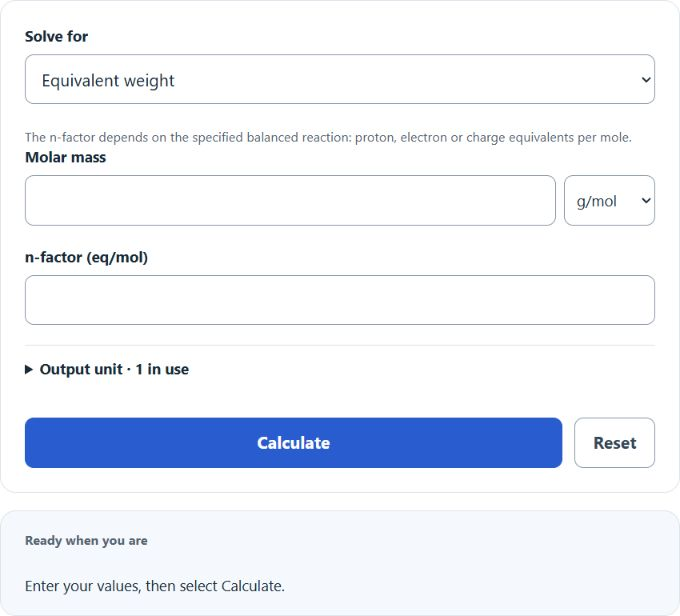
Calculate equivalent weight, molar mass, or n-factor from any two inputs, with unit conversions for g/mol, kg/mol, mg/mol, and lb/mol.
- Normality to Grams Calculator
- Normality to Molarity Converter
- Molarity Calculator
- Moles to Mass Calculator
- Molarity to Moles Calculator
- All Chemistry Calculators
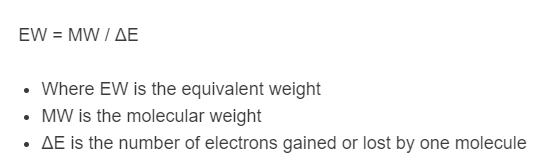
Equivalent Weight Formula
The equivalent weight is the molar mass divided by the n-factor. The n-factor is the number of equivalents per mole, such as electrons transferred in a redox reaction, hydrogen ions supplied by an acid, hydroxide ions supplied by a base, or total ionic charge in some salt reactions.
- EW = equivalent weight, or equivalent mass, in g/eq
- M = molar mass in g/mol
- n = n-factor, equivalents per mole
If you need to solve for molar mass instead, rearrange the formula:
If you need to solve for the n-factor, rearrange the formula:
- Calculate equivalent weight: enter molar mass and n-factor. The calculator divides molar mass by n.
- Calculate molar mass: enter equivalent weight and n-factor. The calculator multiplies equivalent weight by n.
- Calculate n-factor: enter molar mass and equivalent weight. The calculator divides molar mass by equivalent weight.
- Unit handling: molar mass is converted to g/mol and equivalent weight is converted to g/eq before calculation, then the result is converted back to the selected unit.
Common n-Factors for Equivalent Weight Calculations
The correct n-factor depends on the reaction. The same compound can have different n-factors in different reactions, especially in redox chemistry.
| Type of substance or reaction | How to choose n | Example |
|---|---|---|
| Acid | Number of replaceable H+ ions per formula unit | H2SO4: n = 2 |
| Base | Number of OH– ions per formula unit | Ca(OH)2: n = 2 |
| Redox reaction | Number of electrons gained or lost per formula unit in the balanced reaction | Fe2+ to Fe3+: n = 1 |
| Salt or ion | Often based on total positive or negative charge, depending on the reaction | Al3+: n = 3 |
| Unit selected | Conversion to base unit |
|---|---|
| g/mol or g/eq | Multiply by 1 |
| kg/mol or kg/eq | Multiply by 1000 |
| mg/mol or mg/eq | Multiply by 0.001 |
| lb/mol or lb/eq | Multiply by 453.59237 |
Example Calculations
Example 1: Calculate equivalent weight from molar mass and n-factor
A compound has a molar mass of 98.079 g/mol and an n-factor of 2.
The equivalent weight is 49.0395 g/eq.
Example 2: Calculate n-factor from molar mass and equivalent weight
A substance has a molar mass of 158.034 g/mol and an equivalent weight of 31.6068 g/eq.
The n-factor is 5.
FAQ
What is equivalent weight?
Equivalent weight is the mass of one equivalent of a substance. In most chemistry calculations, it is found by dividing molar mass by the n-factor. For example, if a substance has a molar mass of 100 g/mol and an n-factor of 2, its equivalent weight is 50 g/eq.
How do I know what n-factor to use?
Use the value that matches the reaction type. For acids, it is usually the number of replaceable H+ ions. For bases, it is usually the number of OH– ions. For redox reactions, it is the number of electrons transferred per formula unit in the balanced reaction. Always base the n-factor on the actual balanced reaction, not just the compound formula.
Why does equivalent weight change for the same compound?
Equivalent weight can change because the n-factor can change. A compound may donate different numbers of ions or transfer different numbers of electrons depending on the reaction. Since equivalent weight equals molar mass divided by n, a different n-factor gives a different equivalent weight.