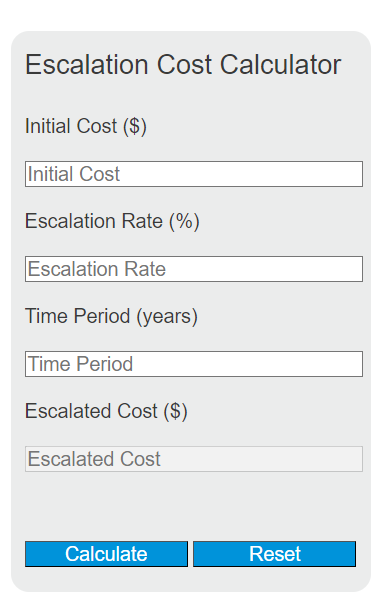
Calculate escalated cost, initial cost, escalation rate, or time period by entering any three values in the cost escalation formula.
Escalation Cost Formula
- EC = Escalated Cost ($)
- IC = Initial Cost ($)
- ER = Escalation Rate (as a decimal; e.g., 5% = 0.05)
- TP = Time Period (years)
Because the formula compounds annually, a 5% rate applied over 10 years produces a 62.9% total cost increase, not 50%. In project budgeting, TP is typically the period from the estimate date to the mid-point of construction, since costs are incurred throughout the schedule rather than all at once at completion.
What is Escalation Cost?
Escalation cost is the projected future cost of a good, service, or project after accounting for cumulative price increases over time. It is used primarily in construction, infrastructure, defense procurement, and long-term service contracts where bids are submitted months or years before costs are actually incurred. Escalation is shown as a separate line item in budget estimates and applied to each cost category (labor, materials, equipment) individually, since each escalates at a different rate. For multi-phase projects, escalation is calculated per phase or contract package and summed for total project escalation.
Escalation Cost vs. Inflation
CPI (Consumer Price Index) measures general consumer price changes. Construction escalation tracks input-specific price shifts in labor, materials, and equipment, which routinely diverge from CPI. In 2021, US CPI averaged 4.7% while residential construction escalation hit 14%. Escalation clauses in contracts typically reference the Producer Price Index (PPI) or the Engineering News-Record Construction Cost Index (ENR CCI) rather than CPI, since these more accurately track actual construction input costs. A key distinction: escalation can be negative for specific materials even during periods of high general inflation, as seen when lumber prices fell over 60% from their May 2021 peak while CPI remained elevated through 2022.
Historical US Construction Cost Escalation
| Year | Residential | Nonresidential | Key Driver |
|---|---|---|---|
| 2018 | ~4% | ~5% | Labor tightness, steel tariffs |
| 2019 | ~3% | ~3.5% | Stable commodity prices |
| 2020 | 4.5% | ~2.5% | Lumber spike, COVID supply disruptions |
| 2021 | 14% | ~11% | Supply chain collapse, widespread material shortages |
| 2022 | 15.8% | ~12% | Record high; energy, steel, and concrete surged |
| 2023 | ~5% | 8.2% | Normalizing materials, persistent labor cost pressure |
| 2024 | ~2.3% | ~2.2% | Near historical norms; labor market remains tight |
What Drives Escalation Cost
The ENR Construction Cost Index weights its four components as follows: labor 81%, structural steel 13%, lumber 5%, portland cement 1%. Because labor dominates the index, markets with skilled-worker shortages see elevated escalation even when commodity prices stabilize. From Q3 2023 to Q1 2024, US construction job openings reached the highest February total in the 24-year history of BLS tracking, keeping labor escalation near 2.7% annually even as materials costs fell 3.5% overall. This component imbalance means that applying a single blended rate (such as CPI) often underestimates true project cost growth in labor-intensive trades.
Escalation by Project Type
Each building type uses trades in different proportions, so two projects in the same city and year can experience substantially different escalation rates. Formwork is a major cost driver in high-rise residential construction but largely absent in warehouses, creating divergent escalation trajectories even in identical market conditions.
| Project Type | Typical Annual Escalation (Stable Market) | Primary Cost Driver |
|---|---|---|
| High-Rise Residential | ~8.7% | Formwork and skilled labor intensity |
| Commercial Office | 4-6% | Mixed trades, HVAC, finishes |
| Industrial / Warehouse | ~3.4% | Structural steel, simple systems |
| Infrastructure / Civil | 3-5% | Aggregate, steel, fuel costs |
| General Long-Term Benchmark | 3-5% | Weighted average across all sectors |
How to Calculate Escalation Cost
- Determine the initial cost (IC) of the item or project at the estimate date.
- Identify the annual escalation rate (ER) appropriate to the cost category. Use trade-specific indices (ENR CCI, RS Means, PPI) rather than general CPI for accuracy.
- Set the time period (TP). For project budgeting, use the period from the estimate date to the mid-point of construction, not the project completion date.
- Apply the formula: EC = IC x (1 + ER)^TP.
- For multi-category projects, calculate escalation separately for labor, materials, and equipment, then sum for total escalated project cost.
Example Problem:
A school construction project is estimated today at $8,000,000. Construction starts in 1 year and takes 2 years to complete, placing the mid-point 2 years from now. The applicable escalation rate for this region and building type is 4.5%.
IC = $8,000,000 | ER = 0.045 | TP = 2 years (to construction mid-point)
EC = $8,000,000 x (1.045)^2 = $8,732,050
Escalation allowance = $732,050 (9.15% of original estimate). This figure is shown as a separate line item in the project budget.