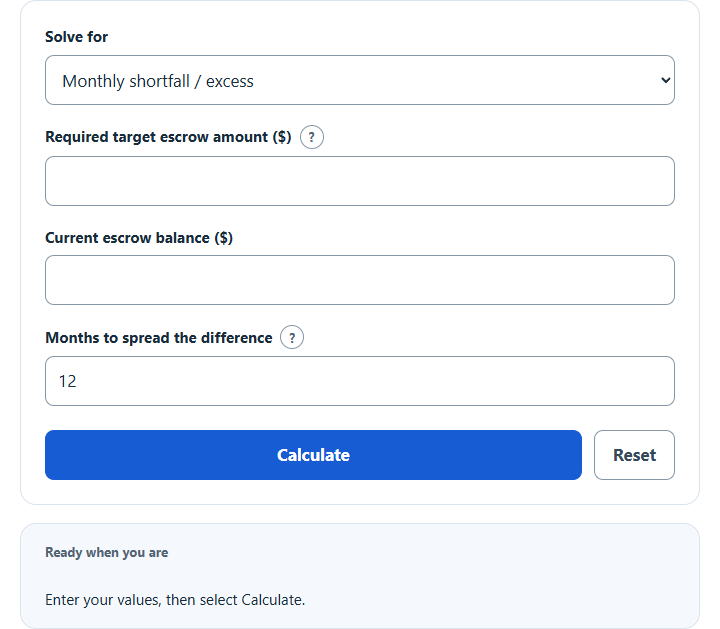
Calculate your escrow shortage and the extra monthly payment to repay it over 12 months, from your escrow target amount and current escrow balance.
Escrow Shortage Formula
This simplified calculator divides the difference between an entered target amount and current balance over a chosen period. Use the target balance from your escrow statement for the date of the analysis.
To estimate the base monthly escrow deposit, add the property tax, insurance and other bills your servicer expects to pay from escrow over 12 months, then divide by 12. Multiply that monthly amount by the number of cushion months to estimate the reserve. For U.S. mortgage escrow accounts covered by Regulation X, the cushion can be at most two months of base deposits. State law or your loan documents may set a lower limit, and your servicer may use a smaller cushion or none.
The target balance varies by month because bills and deposits are scheduled at different times. In an aggregate escrow analysis, the servicer projects the monthly balances, raises the lowest projected balance to zero, then adds the permitted cushion. The cushion is the buffer at the low point of that projection.
- TA = required target escrow amount or stated planning target, in dollars
- EA = existing amount in the escrow account, in dollars
- ES = escrow shortage per month, in dollars
- M = chosen months to spread the difference; actual repayment terms come from the servicer
To solve for a missing value, the same formula is rearranged:
- Calculate TA: use this when you know the current escrow balance, the monthly shortage, and the number of months remaining.
- Calculate EA: use this when you know the target balance, the monthly shortage, and the months to repay.
- Calculate M: use this when you know the total shortage amount and the monthly shortage payment.
- Calculate ES: use this to find how much extra you need to pay each month to cover the escrow shortage over the remaining months.
Common Escrow Items and Shortage Causes
Escrow shortages often happen when the costs paid from escrow increase or when the account balance is lower than expected.
| Escrow item | How it can create a shortage |
|---|---|
| Property taxes | A tax assessment increase can raise the annual amount your lender must collect. |
| Homeowners insurance | A higher renewal premium can increase your required escrow balance. |
| Mortgage insurance or other escrowed charges | Changes in required escrowed costs can affect the total annual amount needed. |
| Prior underpayment | If too little was collected earlier in the year, the shortage may need to be spread over later months. |
| Shortage amount | Months to repay | Added monthly escrow payment |
|---|---|---|
| $600 | 12 | $50.00 |
| $900 | 12 | $75.00 |
| $1,200 | 12 | $100.00 |
| $1,200 | 6 | $200.00 |
Example Escrow Shortage Calculations
Example 1: Calculate the monthly escrow shortage
For an arithmetic planning example, your target amount is $4,800 and current balance is $3,900. Spreading the $900 difference over 12 months gives the following result; this does not itself establish a regulatory shortage.
The escrow shortage is $75.00 per month.
Example 2: Calculate the target balance
Your escrow account currently has $2,700. You are short $125 per month, and there are 8 months remaining.
The implied target balance is $3,700.00.
FAQ
What does an escrow shortage mean?
An escrow shortage is the amount by which your current balance falls below the target balance at the time of your servicer’s escrow analysis. If the shortage is spread over several months, the monthly shortage amount is the extra amount added to your regular mortgage payment.
Why did my escrow payment increase?
Your escrow payment can increase if property taxes, homeowners insurance, or other escrowed charges go up. It can also increase if your lender paid more from the escrow account than expected during the prior year, leaving a shortage that has to be repaid.
Is an escrow shortage the same as a mortgage payment increase?
Not exactly. The shortage affects the escrow portion of your mortgage payment, not the principal and interest portion of a fixed-rate mortgage. Your total monthly payment can still rise because the lender collects more for escrow to cover the shortage and future escrow costs.