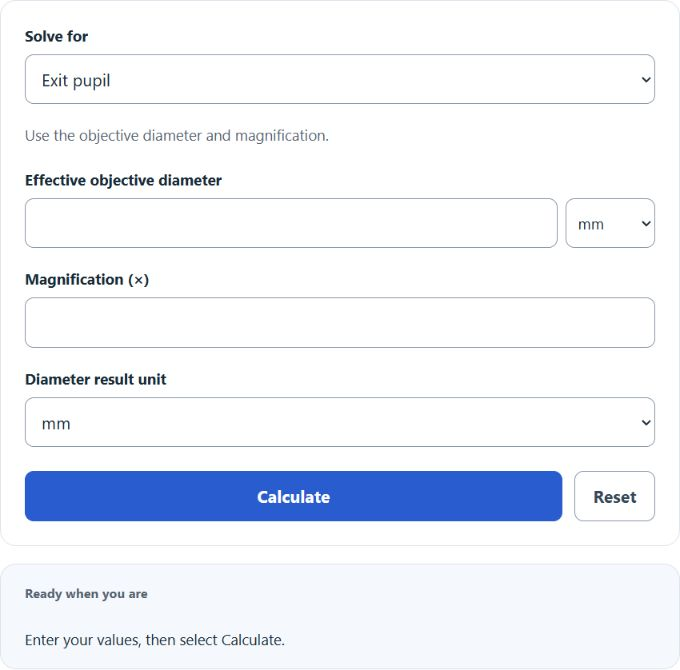
Calculate telescope exit pupil, objective lens diameter, or magnification from any two values with mm, cm, in, or ft unit conversion.
Exit Pupil Formula
The exit pupil is the diameter of the light beam leaving an optical device, such as binoculars, a telescope, or a spotting scope. The calculator uses the objective lens diameter and magnification to calculate the missing value.
- EP = exit pupil diameter
- D = diameter of the objective lens
- M = magnification
The calculator converts objective diameter and exit pupil values to millimeters before applying the formula. If you enter values in centimeters, inches, or feet, they are converted to millimeters for the calculation, then converted back to the selected output unit.
- To calculate exit pupil: enter the objective lens diameter and magnification.
- To calculate objective lens diameter: enter the exit pupil and magnification.
- To calculate magnification: enter the objective lens diameter and exit pupil.
Typical Exit Pupil Sizes
Use this table to understand what different exit pupil results generally mean in practical viewing.
| Exit Pupil | Typical Use | What It Means |
|---|---|---|
| 1 mm to 2 mm | High magnification viewing | Dimmer image, more sensitive to eye position |
| 2 mm to 4 mm | Daytime spotting, birding, general use | Balanced brightness and magnification |
| 4 mm to 7 mm | Low light, astronomy, marine viewing | Brighter image if your eye pupil can use the light |
| Above 7 mm | Very low magnification or large objectives | Extra light may be wasted because the human pupil usually cannot open that wide |
Common Binocular Exit Pupil Values
| Binocular Size | Formula | Exit Pupil |
|---|---|---|
| 8×32 | 32 ÷ 8 | 4.0 mm |
| 8×42 | 42 ÷ 8 | 5.25 mm |
| 10×42 | 42 ÷ 10 | 4.2 mm |
| 10×50 | 50 ÷ 10 | 5.0 mm |
| 7×50 | 50 ÷ 7 | 7.14 mm |
Example Calculations
Example 1: Calculate exit pupil
You have binoculars with a 42 mm objective lens and 8x magnification.
The exit pupil is 5.25 mm.
Example 2: Calculate magnification
You know the objective lens is 50 mm and the exit pupil is 5 mm.
The magnification is 10x.
FAQ
What is a good exit pupil size?
A good exit pupil size depends on lighting and use. For daytime viewing, about 2 mm to 4 mm is usually enough. For low light, twilight, or astronomy, 4 mm to 7 mm can provide a brighter image if your eye pupil is large enough to use the extra light.
Why is exit pupil measured in millimeters?
Exit pupil is a physical diameter, so it is measured as a length. Millimeters are standard because telescope, binocular, and camera optics commonly list objective lens diameter in millimeters.
Does a larger exit pupil always mean a brighter image?
Not always. A larger exit pupil can deliver more light, but your eye can only use light that fits through your own pupil. In bright conditions, your eye pupil may be only 2 mm to 3 mm wide, so a larger exit pupil may not make the image look brighter.