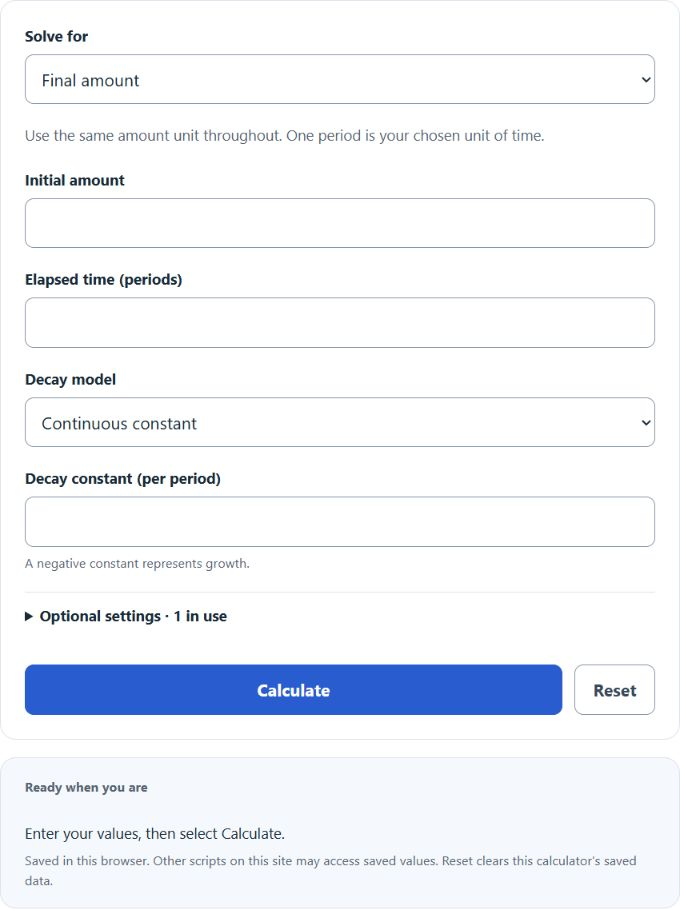
Calculate exponential decay using N(t) = N0 * e^(-kt). Solve for the final amount, initial amount, decay constant, percent rate, elapsed time, or half-life.
Exponential Decay Formula
Exponential decay describes a quantity that drops by the same proportion over each equal step of time. The calculator supports three equivalent models, so use the one that matches the information you have.
Continuous decay using a decay constant k:
N(t) = N0 * e^(-k*t)
Percent decay per period using a rate r:
N(t) = N0 * (1 - r)^t
Half-life decay using the time T it takes the amount to halve:
N(t) = N0 * (1/2)^(t / T)
The decay constant and the half-life are linked by this relationship:
T = ln(2) / k
- N(t): the amount remaining after time t.
- N0: the initial amount at time zero.
- k: the continuous decay constant, in units of 1 over time.
- r: the fraction lost per period, entered as a percent in the calculator.
- T: the half-life, the time for the amount to fall to half its value.
- t: elapsed time in periods. Half-life uses the same period; k is per period, and r is the fraction lost per period.
- e: Euler’s number, about 2.71828.
The “Solve for” selector controls which value is returned. Choose the final amount when you know the starting amount and how long decay has run. Choose the initial amount to work backward from a current reading. Choose the decay rate or constant when you know two amounts and the time between them. Choose elapsed time to find how long it takes to reach a target amount. The “Decay model” selector tells the calculator whether your rate input is a continuous constant k, a percent per period r, or a half-life T, and it converts between them internally.
Decay Models and Half-Life Reference
The table below shows how to pick a model and what each rate input means.
| Model | Rate input | Use when |
|---|---|---|
| Continuous (k) | Decay constant k | Radioactive decay, cooling, drug elimination |
| Percent per period (r) | Percent lost each step | Depreciation, year-over-year decline |
| Half-life (T) | Time to halve | Isotopes, medication, any quoted half-life |
This table shows the fraction of the original amount remaining after a whole number of half-lives.
| Half-lives elapsed | Fraction remaining | Percent remaining |
|---|---|---|
| 1 | 1/2 | 50% |
| 2 | 1/4 | 25% |
| 3 | 1/8 | 12.5% |
| 4 | 1/16 | 6.25% |
| 5 | 1/32 | 3.125% |
Example Problems
Example 1: Continuous decay. A sample starts at N0 = 500 units with a decay constant k = 0.05 per year. After t = 10 years, the remaining amount is N(t) = 500 * e^(-0.05 * 10) = 500 * e^(-0.5) = 500 * 0.6065 = 303.3 units.
Example 2: Half-life. An idealized sample has a half-life of T = 6 hours and an initial amount of N0 = 200 mg. After t = 18 hours, which is 3 half-lives, the amount left is N(t) = 200 * (1/2)^(18 / 6) = 200 * (1/2)^3 = 200 * 0.125 = 25 mg.
Frequently Asked Questions
What is the difference between the decay constant and the decay rate? The decay constant k applies to continuous decay and is used in the term e^(-k*t). The percent rate r applies to decay measured once per period and is used in (1 – r)^t. They describe the same process but are not numerically equal. For small rates they are close, but they diverge as the rate grows, which is why the calculator asks you to pick a model.
How do I find the half-life from a decay constant? Divide the natural log of 2 by the decay constant: T = ln(2) / k, which is about 0.6931 / k. The reverse also holds, so k = ln(2) / T. The calculator converts the selected model internally when you calculate; changing the selector changes which parameter you enter.
Can exponential decay reach zero? No. The amount keeps getting smaller but never reaches exactly zero in the model, because each step removes a proportion of what remains rather than a fixed quantity. In practice the value becomes negligibly small after enough half-lives, as the table above shows.