Calculate a facial attractiveness index from your own 1–10 feature ratings, or score face proportions, symmetry and face shape from measurements.
- Every Day Life And Education Calculators
- Facial Golden Ratio Calculator
- FWHR Calculator
- Midface Ratio Calculator
Calculator Functions
| Function | What it does | What it requires |
|---|---|---|
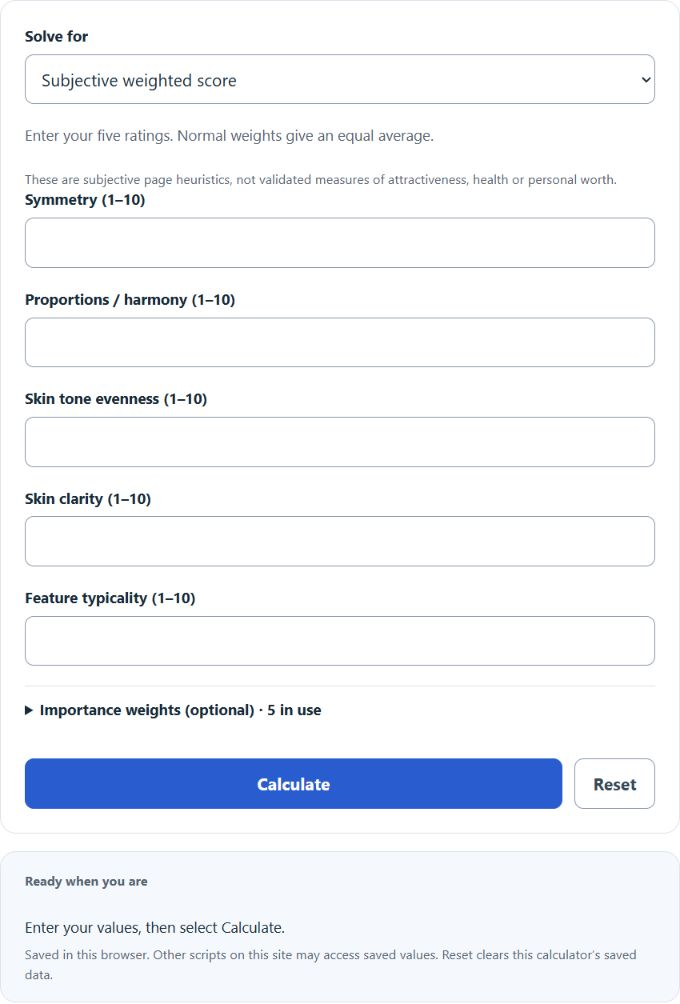
| Subjective weighted score | Combines five ratings into one score out of 10 and out of 100 | Requires a rating from 1 to 10 for symmetry, proportions, skin tone evenness, skin clarity and feature typicality; importance weights are optional |
| Proportion heuristic | Scores how close three face ratios and the facial thirds are to set targets | Requires nine measurements in one unit: face length, face width, mouth width, nose width, single eye width, interpupillary distance and the upper, middle and lower thirds |
| Symmetry heuristic | Scores how closely left and right measurements match | Requires the left and right eye widths, nostril widths and mouth corner to midline distances |
| Face shape heuristic | Names a face shape from four measurements | Requires the face length, forehead width, cheekbone width and jawline width |
Measurements can be in pixels from a photo, millimeters or centimeters, as long as one unit and one view are used throughout. Every score is this calculator’s own estimate. None is a scientific or clinical measure.
Facial Attractiveness Index Formula
| FAI | Score from 1 to 10 |
| r | Each of the five ratings, from 1 to 10 |
| w | Importance weight of that rating: 0.5, 1, 1.5 or 2 |
Subjective weighted score
Ratings of 8 for symmetry, 6 for proportions, 7 for skin tone evenness, 8 for skin clarity and 9 for typicality, all at the normal weight of 1, give 38 ÷ 5 = 7.6 out of 10, or 76 out of 100. Raising the symmetry weight to 2 gives (16 + 6 + 7 + 8 + 9) ÷ 6 = 7.6667. The score out of 100 is labeled low below 55, moderate from 55, high from 70 and very high from 85. Symmetry, averageness and skin condition are traits that research links to how attractive a face is judged [1], but the ratings are the rater’s opinion, and the weights and labels are this calculator’s own.
Proportion heuristic
d is how far a ratio is from its target, as a fraction of the target, and a score cannot go below 0. The targets are 1.618 for face length ÷ face width and for mouth width ÷ nose width, and 2 for interpupillary distance ÷ eye width. A fourth score compares the three facial thirds with their own average in the same way. The result is the average of the four. A face 180 long and 120 wide, with a 50 mouth, a 35 nose, 30 eyes, 62 between the pupils and thirds of 60, 62 and 58, scores 89.06, 82.44, 95.00 and 96.67, an average of 90.79 out of 100.
The 1.618 targets follow the golden ratio tradition. A study that varied face proportions found little support for the golden ratio: the proportions rated most attractive matched those of an average face [2].
Symmetry heuristic
|L − R| ÷ m
L and R are the left and right measurements and m is their average. Eye widths of 30 and 29 score 100 − 200 × 1 ÷ 29.5 = 93.22, equal nostrils score 100, and mouth distances of 25 and 24 score 91.84. The result is the average, 95.02 out of 100, and the asymmetry index is 100 minus that, 4.98.
Face shape heuristic
The shape comes from a fixed set of rules. A face length of at least 1.5 times the cheekbone width is Oblong. Otherwise the widths are compared, and two widths count as similar when they differ by no more than 5% of the cheekbone width. Forehead and jawline both similar to the cheekbones is Round when length ÷ cheekbone width is under 1.1 and Square when it is not. A forehead wider than the cheekbones with a jawline narrower than them is Heart. Cheekbones wider than both the forehead and the jawline is Diamond. Anything else is Oval. A face 190 long with a 130 forehead, 135 cheekbones and a 120 jawline has a ratio of 1.41, a similar forehead and a narrower jawline, so it is Diamond.
Limits of This Estimate
- There is no single accepted facial attractiveness index. The formulas, targets, weights and labels here were chosen for this calculator. These estimates are based on the best available data and estimations.
- People agree with each other about attractiveness to a large degree, but individual and cultural differences exist [1], and five self-chosen ratings cannot capture them.
- Measurements taken from a photo change with camera angle, lens, distance and expression.
- The results are not a medical, psychological or cosmetic assessment.
Sources
- Little, Jones and DeBruine, Facial attractiveness: evolutionary based research, Philosophical Transactions of the Royal Society B, 2011: traits linked to attractiveness judgements, and agreement and differences between people
- Pallett, Link and Lee, New “golden” ratios for facial beauty, Vision Research, 2010: preferred face proportions and the golden ratio