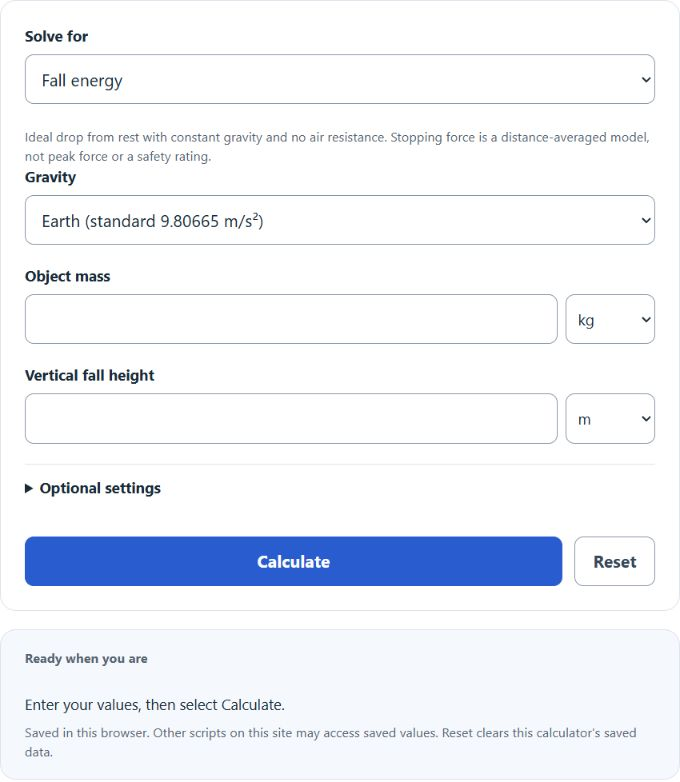
Calculate the energy of a falling object from its mass and drop height, with impact speed, fall time and the average impact force over a stopping distance.
Calculator Functions
| Function | What it does | What it requires |
|---|---|---|
| Fall energy | Finds the energy an object gains in a fall | Requires the object mass and the vertical fall height |
| Object mass | Finds the mass that reaches a known energy over a fall height | Requires the fall energy and the vertical fall height |
| Fall height | Finds the drop needed for a mass to reach a known energy | Requires the fall energy and the object mass |
Every function also asks for gravity: Earth (9.80665 m/s²), the Moon (1.62 m/s²), Mars (3.721 m/s²) or a custom value. Mass is in kg or lb, height in m, ft or in, and energy in J or ft·lbf, converted with the standard factors [7]. Each result lists the impact speed, fall time and impact momentum. An optional stopping distance adds the average force during the impact.
Fall Energy Formulas
| E | Fall energy (J) |
| m | Mass of the falling object (kg) |
| g | Acceleration of gravity (m/s²) |
| h | Vertical fall height (m) |
This is the potential energy the object loses over the drop, which becomes kinetic energy by the time it lands if nothing else slows it [1]. Earth uses the standard acceleration of gravity, exactly 9.80665 m/s² [2]. The Moon uses 1.62 m/s² [3]. Mars uses 3.721 m/s², close to the 3.73 m/s² mean surface gravity NASA lists [4].
Fall energy
A 50 kg object falling 40 m on Earth gains 50 × 9.80665 × 40 = 19,613.3 J. With g rounded to 9.81 the same drop gives 19,620 J. A 10 lb object falling 20 ft is 4.536 kg over 6.096 m, or 271.16 J.
Object mass
19,613.3 J over a 40 m drop on Earth is 19,613.3 ÷ (9.80665 × 40) = 50 kg.
Fall height
A 50 kg object reaches 19,613.3 J after 19,613.3 ÷ (50 × 9.80665) = 40 m.
Impact speed, fall time and momentum
Setting the fall energy equal to the kinetic energy ½ × m × v² gives the speed at impact [1]. Every object dropped from the same height lands at the same speed when air resistance is ignored, whatever its mass [5]. The fall time is v ÷ g and the momentum is m × v. The 40 m drop gives 28.01 m/s (62.66 mph), 2.856 s and 1,400.5 kg·m/s for the 50 kg object.
Force of a falling object
A falling object has no single impact force. The force depends on the distance d over which it stops, because the work done in stopping it is force times distance [6]. The m × g term is there because gravity keeps acting while the object slows. If the 50 kg object from 40 m stops over 0.5 m, the average force is 19,613.3 ÷ 0.5 + 490.3 = 39,716.9 N. Halving the stopping distance roughly doubles it.
Limits of This Estimate
- Air resistance is ignored, so real impact speeds and energies are lower, most of all for light objects and long drops.
- The object is taken to start from rest and fall straight down under constant gravity.
- The force is an average over the stopping distance. The peak force is higher and depends on the materials, so this result should not be used to rate fall-protection equipment or to judge injury risk.
- The Mars value of 3.721 m/s² is an approximate surface figure, and published values range from 3.69 to 3.73 m/s² [4]. These estimates are based on the best available data and estimations.
Sources
- NASA Glenn Research Center, Energy Activity: potential energy m × g × h and kinetic energy ½ × m × V²
- NIST, CODATA value: standard acceleration of gravity: 9.80665 m/s², exact
- NASA Goddard, Moon Fact Sheet: Moon surface gravity of 1.62 m/s²
- NASA Goddard, Mars Fact Sheet: Mars surface gravity of 3.73 m/s² mean and 3.69 m/s² at the equator
- NASA Glenn Research Center, Free Fall without Air Resistance: all objects fall with the same acceleration without air resistance
- NASA Glenn Research Center, Work: work as force times distance
- NIST Special Publication 811, Appendix B.8: lb, ft, in and ft·lbf conversion factors