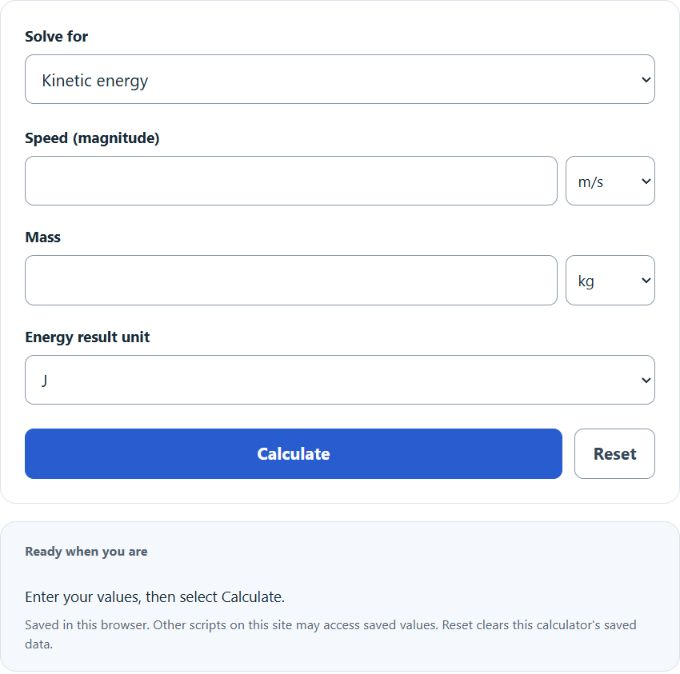
Calculate speed, mass, or kinetic energy by choosing a result and entering the two known quantities with units in m/s, km/h, mph, kg, lb, J, kcal, or BTU (International Table).
- All Physics Calculators
- All Energy Calculators
- Speed to Acceleration Calculator
- Speed to Velocity Calculator
- Force to Energy Calculator
- Fall Energy Calculator
- Acceleration to Energy Calculator
Energy from Speed Formula
The following equation is used to calculate the Energy from Speed.
Variables:
- Where E is the Energy from Speed (joules)
- S is the total speed (m/s)
- m is the mass of the moving object (kg)
To calculate energy from speed, square the speed, multiply by the mass, then divide by 2.
| Speed (m/s) | Energy (J) |
|---|---|
| 0.5 | 0.125 |
| 1 | 0.500 |
| 1.5 | 1.125 |
| 2 | 2.000 |
| 3 | 4.500 |
| 4 | 8.000 |
| 5 | 12.500 |
| 7.5 | 28.125 |
| 10 | 50.000 |
| 12 | 72.000 |
| 15 | 112.500 |
| 20 | 200.000 |
| 25 | 312.500 |
| 30 | 450.000 |
| 35 | 612.500 |
| 40 | 800.000 |
| 45 | 1012.500 |
| 50 | 1250.000 |
| 60 | 1800.000 |
| 100 | 5000.000 |
| Assumes mass m = 1.00 kg. Kinetic energy: E = 0.5 × m × v². Unit tips: 1 m/s = 3.6 km/h; 1 J ≈ 0.000239006 kcal ≈ 0.000947817 BTU (International Table). | |
How to Calculate Energy from Speed?
The following two example problems outline the steps and information needed in order to calculate the Energy from Speed.
Example Problem #1:
- First, determine the total speed (m/s). In this example, the total speed (m/s) is measured to be 571.
- Next, determine the mass of the moving object (kg). For this problem, the mass of the moving object (kg) is calculated to be 48.
- Finally, calculate the Energy from Speed using the formula above:
E = .5*S^2*m
Inserting the values from above and solving the equation with the imputed values gives:
E = .5*571^2*48 =7824984 (joules)
FAQ
What units are used to measure energy in the Energy from Speed formula?
The energy calculated from the speed is measured in joules (J), which is the standard unit of energy in the International System of Units (SI).
Can the Energy from Speed formula be used for any type of motion?
The formula calculates classical translational kinetic energy from instantaneous speed, including during acceleration or curved motion. It excludes rotational and internal energy and requires a relativistic model near light speed.
How does the mass of an object affect its energy from speed?
According to the formula E = .5*S^2*m, the energy from speed is directly proportional to the mass of the object. This means that as the mass increases, the energy from speed also increases, assuming the speed remains constant. This relationship highlights the significant impact of an object’s mass on its kinetic energy.