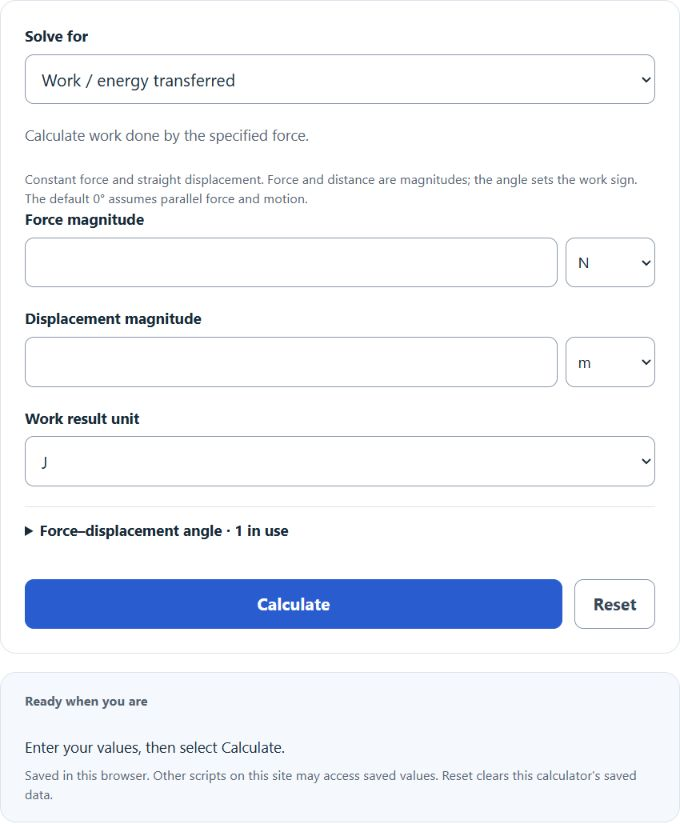
Convert force to energy (work) with W = F × d × cos θ: enter force and distance in N, lbf, m or ft, or solve for force or distance from energy.
- All Energy Calculators
- All Physics Calculators
- Speed to Energy Calculator
- Acceleration to Energy Calculator
Energy from Force Formula
The following equation gives the work done by a constant force over a straight displacement. Work may be positive, negative or zero.
- Where E is the work done (energy transferred) (joules)
- F is the applied force magnitude (N)
- d is the displacement magnitude (m)
- θ is the angle between the force and the displacement
To calculate energy (work) from a force, multiply the force by the displacement and by cos(θ). When the force is along the direction of motion, θ = 0° and the formula simplifies to E = F·d. At 90°, that force does no work; beyond 90° it does negative work. Work by the net force equals the change in kinetic energy; the work of one applied force need not equal the total energy change. The inverse solvers require a nonzero denominator and a work sign consistent with the angle.
| Foot‑pound force (ft·lbf) | Joules (J) |
|---|---|
| 0.25 | 0.339 |
| 0.5 | 0.678 |
| 1 | 1.356 |
| 2 | 2.712 |
| 5 | 6.779 |
| 10 | 13.558 |
| 15 | 20.337 |
| 20 | 27.116 |
| 25 | 33.895 |
| 30 | 40.675 |
| 40 | 54.233 |
| 50 | 67.791 |
| 75 | 101.686 |
| 100 | 135.582 |
| 150 | 203.373 |
| 200 | 271.164 |
| 250 | 338.954 |
| 300 | 406.745 |
| 500 | 677.909 |
| 1000 | 1355.818 |
| Conversions use 1 ft·lbf = 1.3558179483314 J exactly; table values are rounded. Inverse: 1 J ≈ 0.737562 ft·lbf. | |
How to Calculate Energy from Force?
The following example problems outline the steps and information needed to calculate the Energy from Force.
Example Problem #1
- First, determine the total force (N). In this example, the total force is 4 N.
- Next, determine the distance (m). For this problem, the distance is 8 m.
- Next, determine the angle between the force and displacement. In this case, the force is along the direction of motion, so θ = 0°.
- Finally, calculate the Energy from Force using the formula above.
E = F*d*cos(θ)
Inserting the values from above and solving the equation yields:
E = 4*8*cos(0°) = 32 (joules)
Example Problem #2
Using the same method as above, first, we need to measure or determine the variables required by the equation. For this example problem, these are provided as follows:
total force (N) = 9
distance (m) = 4
angle (θ) = 0°
Entering these given values into the calculator or the formula above yields:
E = 9*4*cos(0°) = 36 (joules)