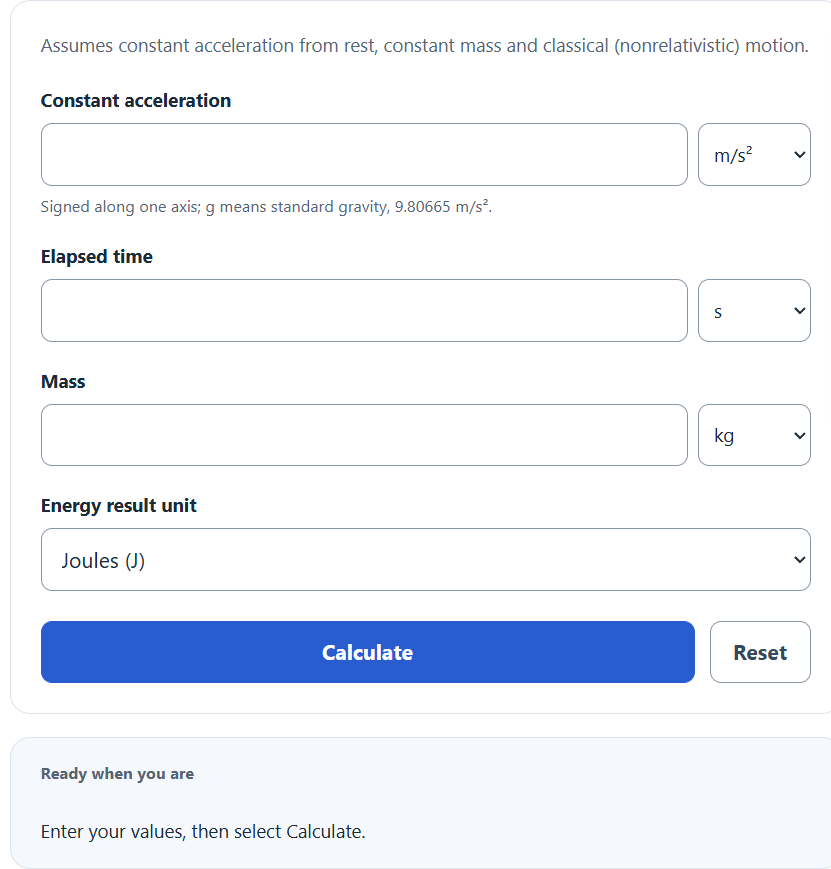
Calculate kinetic energy gained from acceleration, time, and mass, with results in J, kJ, or BTU after unit conversion from rest conditions.
- All Energy Calculators
- Force to Energy Calculator
- Speed to Energy Calculator
- All Physics Calculators
Acceleration to Energy Formula
The calculator converts acceleration, time, and mass into classical kinetic energy gained. It assumes the object starts from rest and accelerates at a constant rate, at speeds much lower than the speed of light.
- E = kinetic energy gained, in joules before output conversion
- m = mass, converted to kilograms
- v = final velocity, in meters per second
- a = acceleration, converted to meters per second squared
- t = time, converted to seconds
The acceleration and time inputs are first used to find final velocity. That velocity is then used in the kinetic energy formula. The result is calculated in joules, then converted to your selected energy unit: joules, kilojoules, or BTU.
Unit Conversions Used for Acceleration, Time, Mass, and Energy
| Quantity | Unit | Conversion used |
|---|---|---|
| Acceleration | ft/s² | 1 ft/s² = 0.3048 m/s² |
| Acceleration | g | 1 g = 9.80665 m/s² |
| Time | min | 1 min = 60 s |
| Time | hr | 1 hr = 3600 s |
| Mass | lb | 1 lb = 0.45359237 kg |
| Energy | BTU | 1 BTU (IT) ≈ 1055.06 J |
Common Energy Result Sizes
| Energy | Equivalent | How to read it |
|---|---|---|
| 1 J | 0.001 kJ | A small amount of kinetic energy |
| 1,000 J | 1 kJ | Useful for larger moving objects |
| 1 BTU | 1055.06 J | Often used in heat and energy comparisons |
Example Calculations
Example 1: Energy from acceleration in SI units
You have a 10 kg object accelerating at 3 m/s² for 4 seconds.
The kinetic energy gained is 720 J.
Example 2: Energy using pounds and g acceleration
You have a 20 lb object accelerating at 0.5 g for 2 seconds.
- Mass: 20 lb × 0.45359237 = 9.0718474 kg
- Acceleration: 0.5 g × 9.80665 = 4.903325 m/s²
- Velocity: 4.903325 × 2 = 9.80665 m/s
The kinetic energy gained is about 436.22 J.
FAQ
Does this calculate total energy or kinetic energy?
It calculates kinetic energy gained from acceleration. The formula assumes the object starts from rest, so the final velocity is found from acceleration multiplied by time.
What if the object already has an initial velocity?
This calculator does not include initial velocity. If the object already has a starting speed, the final velocity would be different, and the kinetic energy change would need to compare initial kinetic energy and final kinetic energy.
Why does energy increase so much when time or acceleration increases?
Energy depends on velocity squared. Since velocity is acceleration multiplied by time, doubling acceleration or time doubles velocity, but it can make the kinetic energy four times larger.