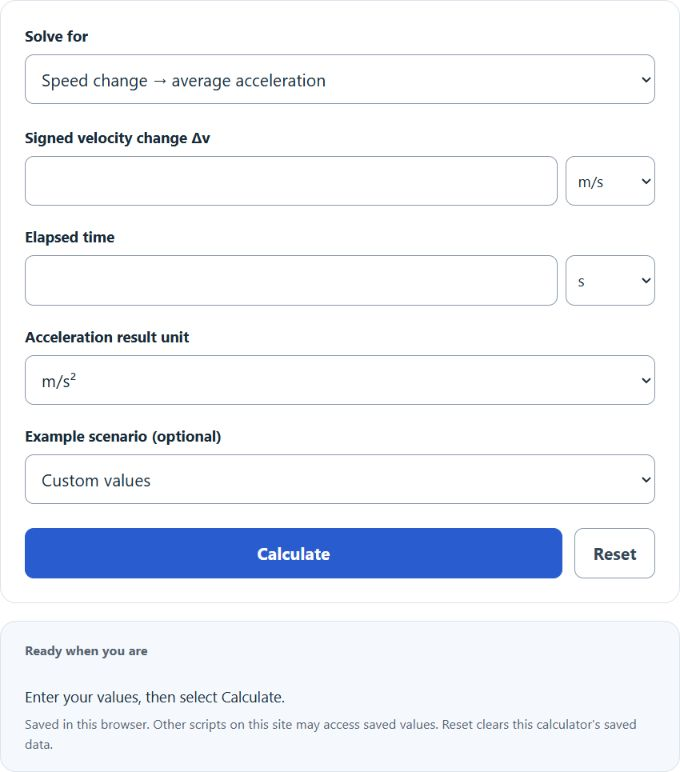
Calculate acceleration from speed change and time, plus signed displacement, centripetal acceleration and braking stopping distance from speed, radius and friction.
Acceleration from Speed Formula
The following equation gives average acceleration from signed velocity change over a positive time interval. Speed change alone describes tangential acceleration; a change in direction can also cause acceleration.
- A is average acceleration (m/s²)
- dS is the signed one-dimensional velocity change (m/s)
- dT is the change in time (s)
Choose the calculation to solve, then enter its known quantities. For average linear acceleration, divide signed velocity change by elapsed time. Displacement modes assume constant acceleration. Braking assumes a level surface and constant friction; its illustrative presets are not reliable stopping-distance guarantees.
What are the units for Acceleration from Speed?
The most common units for Acceleration from Speed are m/s^2.
How to Calculate Acceleration from Speed?
Example Problem:
The following example problem outlines the steps and information required to calculate the Acceleration from Speed.
First, determine the change in speed. In this example, the change in speed is measured to be 35 (m/s).
Next, determine the change in time. For this problem, the change in time is calculated to be 5 (s).
Finally, calculate the Acceleration from Speed using the formula above:
A = dS / dT
Inserting the values from above and solving the equation gives us:
A = 35 / 5 = 7 (m/s^2)
FAQ
What is the significance of measuring acceleration in m/s^2?
Measuring acceleration in meters per second squared (m/s^2) is significant because it provides a clear indication of how quickly an object’s velocity changes over time. This unit is universally accepted in physics and engineering, allowing for consistent communication and calculations regarding motion across different contexts and applications.
Can acceleration be negative?
Yes. Acceleration is negative when it points along the negative direction of the chosen axis. An object slows down when acceleration opposes its velocity; negative acceleration can instead increase speed when velocity is also negative.
How does the concept of acceleration apply to everyday life?
The concept of acceleration applies to everyday life in numerous ways, from driving a car to playing sports. For instance, when a car speeds up, it is accelerating, and the rate of this acceleration can affect fuel efficiency and safety. In sports, athletes’ ability to quickly increase their speed (accelerate) can be crucial to their performance. Understanding acceleration can also help in making predictions about the motion of objects in various situations.