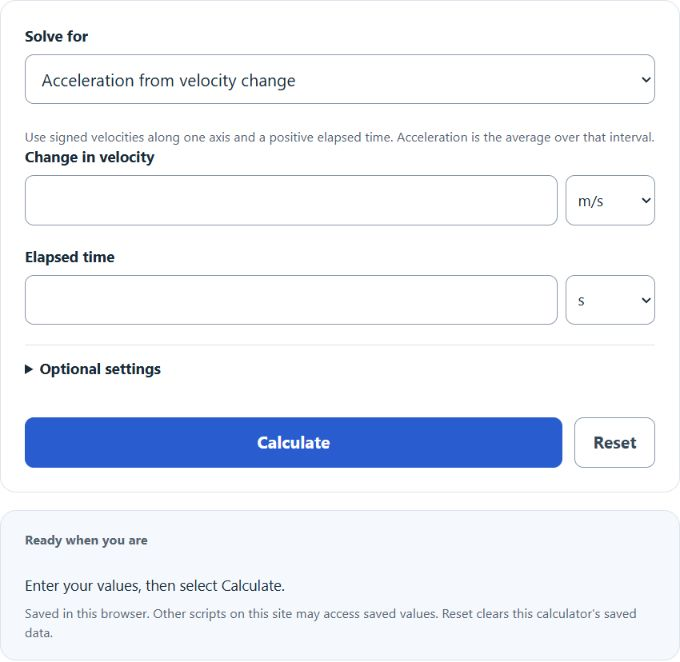
Calculate acceleration, time, change in velocity, or final velocity from initial velocity using m/s, km/h, mph, seconds, minutes, and hours.
- All Physics Calculators
- All Acceleration Calculators
- Acceleration to Velocity Calculator
- Speed to Acceleration Calculator
- Joules to Acceleration Calculator
Velocity to Acceleration Formula
The following finite-interval equation gives average acceleration along one chosen axis. Use signed velocity change and positive elapsed time; instantaneous acceleration is the derivative dv/dt.
- Where A_avg is average acceleration (m/s²)
- ΔV is final velocity minus initial velocity (m/s)
- Δt is the positive elapsed time (s)
To calculate average acceleration, divide signed velocity change by positive elapsed time. Negative acceleration indicates the negative coordinate direction; it can describe speeding up when velocity is also negative.
What are the units for Velocity to Acceleration?
In the International System of Units, also known as SI units, the units for Velocity to Acceleration are m/s^2.
How to Convert Velocity to Acceleration?
Example Problem:
The following example problem outlines the steps and information needed to calculate the Velocity to Acceleration.
First, determine the change in velocity. In this example, the change in velocity is calculated or measured to be 50 (m/s).
Next, determine the time. For this problem, the time is determined to be 2 (s).
Finally, calculate the Velocity to Acceleration using the formula above:
A = dV / dt
Inserting the values from above and solving the equation with the imputed values gives:
A = 50 / 2 = 25 (m/s^2)