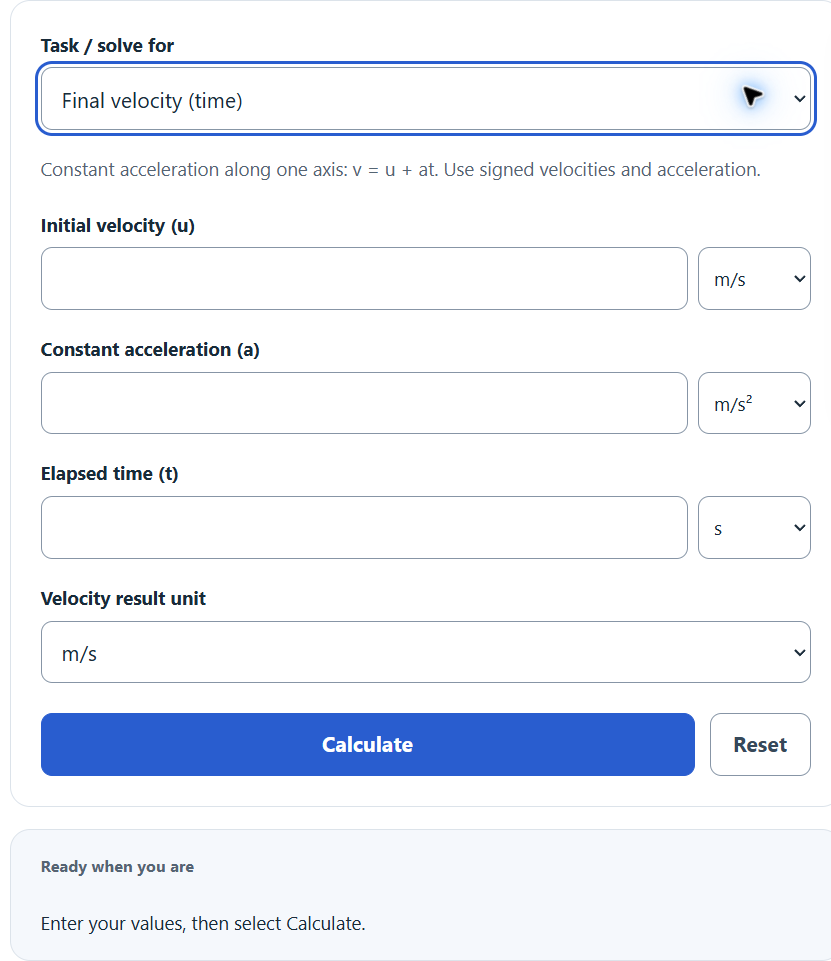
Choose a task and enter its listed inputs to calculate acceleration, velocity, time, displacement, stopping distance, or free-fall values with exact unit controls.
- All Physics Calculators
- All Velocity Calculators
- Acceleration to Distance Calculator
- Acceleration to Force Calculator
- Velocity to Force Calculator
- Mass to Velocity Calculator
- Force to Velocity Calculator
- Kinetic Energy to Velocity Calculator
Acceleration to Velocity Formula
The following equation is used to calculate the velocity from acceleration.
- Where V is the final velocity (m/s)
- Vi is the initial velocity (m/s)
- a is the acceleration (m/s^2)
- t is the change in time (s)
To calculate velocity from acceleration, you first need to calculate the change in velocity by multiplying the acceleration by time, then add the result to the initial velocity, if there was one.
How to Calculate Velocity From Acceleration?
Example Problem:
The following example outlines the steps and information needed to calculate final velocity under constant acceleration.
First, determine the initial velocity. In this example, this is found to be 25 m/s.
Next, determine the acceleration. For this problem, the acceleration is 50 m/s^2.
Next, determine the time. In this case, the change in time is measured to be 5 seconds.
Finally, calculate the velocity using the formula above:
V = Vi + a * t
V = 25 + 50 * 5
V = 275 m/s