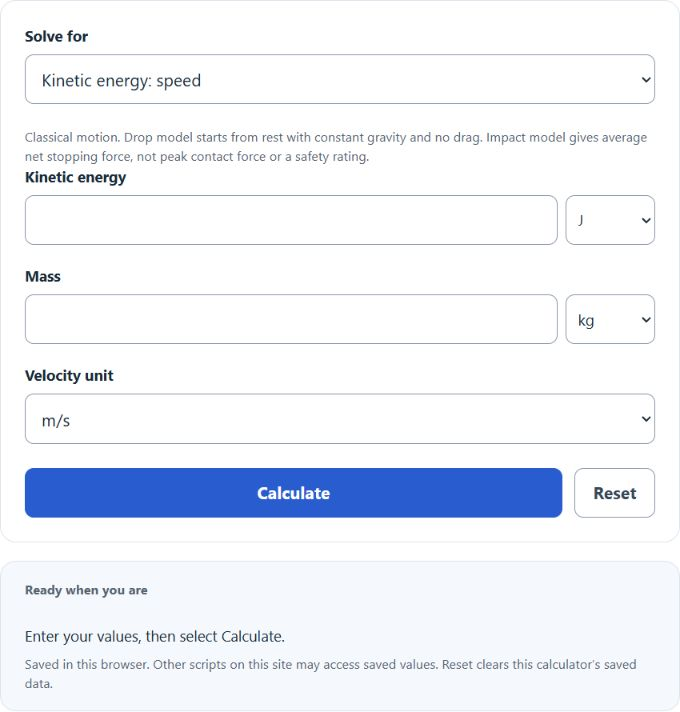
Select a solve mode for kinetic energy, signed momentum, ideal drop height, or average net stopping force. Enter the two known quantities and select Calculate. These classical models do not predict peak contact force or safety.
- All Physics Calculators
- All Velocity Calculators
- Energy To Force Calculator
- Acceleration to Velocity Calculator
- Force to Velocity Calculator
Kinetic Energy to Velocity Formula
The following equation is used to calculate the velocity from kinetic energy.
- Where V is the speed magnitude (m/s); kinetic energy does not determine direction
- KE is the kinetic energy (joules)
- M is the mass (kg)
To calculate the velocity from kinetic energy, multiply the energy by 2, divide by the mass, then take the square root of the result.
| Kinetic Energy (J) | Velocity (m/s) |
|---|---|
| 0.5 | 1.000 |
| 1 | 1.414 |
| 2 | 2.000 |
| 5 | 3.162 |
| 10 | 4.472 |
| 20 | 6.325 |
| 50 | 10.000 |
| 100 | 14.142 |
| 200 | 20.000 |
| 500 | 31.623 |
| 1,000 | 44.721 |
| 2,000 | 63.246 |
| 5,000 | 100.000 |
| 10,000 | 141.421 |
| 20,000 | 200.000 |
| 50,000 | 316.228 |
| 100,000 | 447.214 |
| 200,000 | 632.456 |
| 500,000 | 1,000.000 |
| 1,000,000 | 1,414.214 |
| Assumes mass m = 1.00 kg. Formula: v = √(2E/m). Velocity shown in meters per second. | |
How to Convert Kinetic Energy to Velocity?
Example Problem:
The following example outlines the steps and information needed to convert kinetic energy to velocity.
First, determine the kinetic energy. In this example, the kinetic energy is found to be 500 joules.
Next, determine the mass. For this problem, the mass is found to be 25 kg.
Finally, calculate the velocity from kinetic energy using the formula above:
V = SQRT( KE * 2 / M)
V = SQRT( 500 * 2 / 25)
V ≈ 6.325 m/s
FAQ
What is kinetic energy and how is it calculated?
Kinetic energy is the energy that an object possesses due to its motion. It is calculated using the formula KE = 0.5 * m * v^2, where KE is the kinetic energy in joules, m is the mass of the object in kilograms, and v is the velocity of the object in meters per second (m/s).
Can you convert velocity back into kinetic energy?
Yes, you can convert velocity back into kinetic energy by rearranging the kinetic energy formula. Given the velocity, you can calculate the kinetic energy using KE = 0.5 * m * v^2, where m is the mass of the object and v is its velocity.
Why do you need to multiply the kinetic energy by 2 in the formula to calculate velocity?
Multiplying the kinetic energy by 2 in the formula V = SQRT(KE * 2 / M) is a step derived from rearranging the original kinetic energy formula KE = 0.5 * m * v^2 to solve for velocity (v). This step effectively cancels out the 0.5 factor in the original formula, allowing for the direct calculation of velocity from kinetic energy and mass.