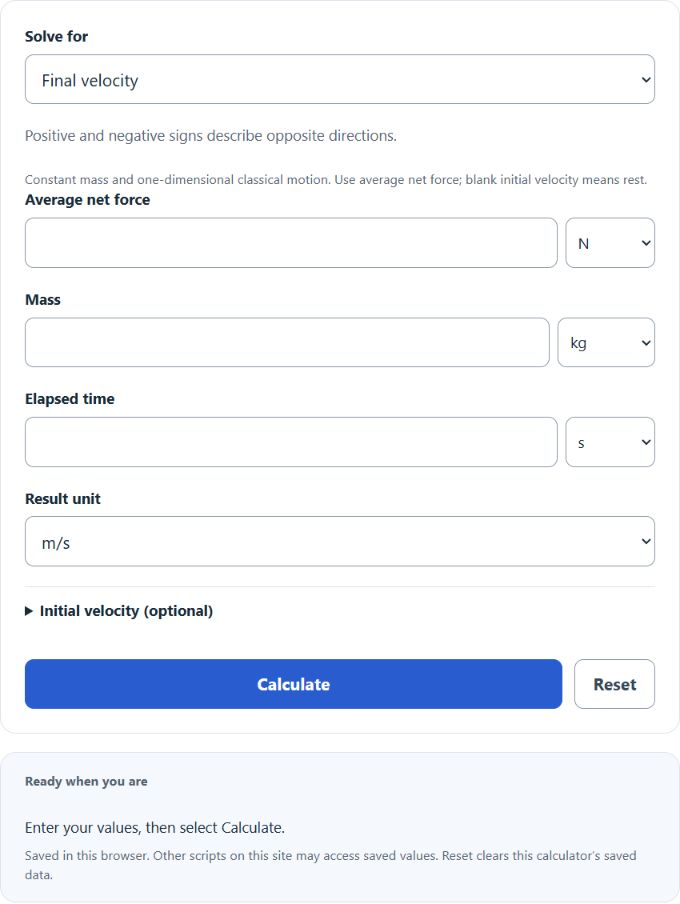
Choose final velocity, average net force, mass or elapsed time, then enter the required values and units. Initial velocity is optional; blank means rest.
- All Physics Calculators
- Mechanics and Physics Unit Converters
- All Velocity Calculators
- Velocity Calculator
- Height to Velocity Calculator
- Acceleration to Velocity Calculator
- Velocity to Force Calculator
- Kinetic Energy to Velocity Calculator
Force to Velocity Formula
For constant mass and one-dimensional classical motion, the following equation gives velocity from rest using average net force over the interval. With an initial velocity, add v₀ to the result.
- V is final velocity from rest (m/s)
- F is the average net force along the chosen direction (N)
- m is the mass (kg)
- t is the time (s)
For motion from rest, divide average net force by mass and multiply by elapsed time. Add the initial velocity when supplied. Signed force and velocity use one consistent direction.
| Meters per second (m/s) | Kilometers per hour (km/h) |
|---|---|
| 0.5 | 1.8 |
| 1 | 3.6 |
| 1.5 | 5.4 |
| 2 | 7.2 |
| 2.5 | 9.0 |
| 3 | 10.8 |
| 3.5 | 12.6 |
| 4 | 14.4 |
| 4.5 | 16.2 |
| 5 | 18.0 |
| 6 | 21.6 |
| 7.5 | 27.0 |
| 8 | 28.8 |
| 9 | 32.4 |
| 10 | 36.0 |
| 12 | 43.2 |
| 15 | 54.0 |
| 20 | 72.0 |
| 25 | 90.0 |
| 30 | 108.0 |
| SI relation: 1 m/s = 3.6 km/h. | |
How to Calculate Velocity From Force?
Example Problem:
The following example assumes motion from rest, a constant 10 kg mass and a 75 N average net force over 2 seconds.
First, determine the force. In this example, the force is found to be 75N.
Next, determine the mass. For this problem, the mass is found to be 10kg.
Next, determine the time. In this case, the time is measured to be 2 seconds.
Finally, calculate the velocity using the formula above:
V = F/m*t
V = 75/10*2
V = 15 m/s