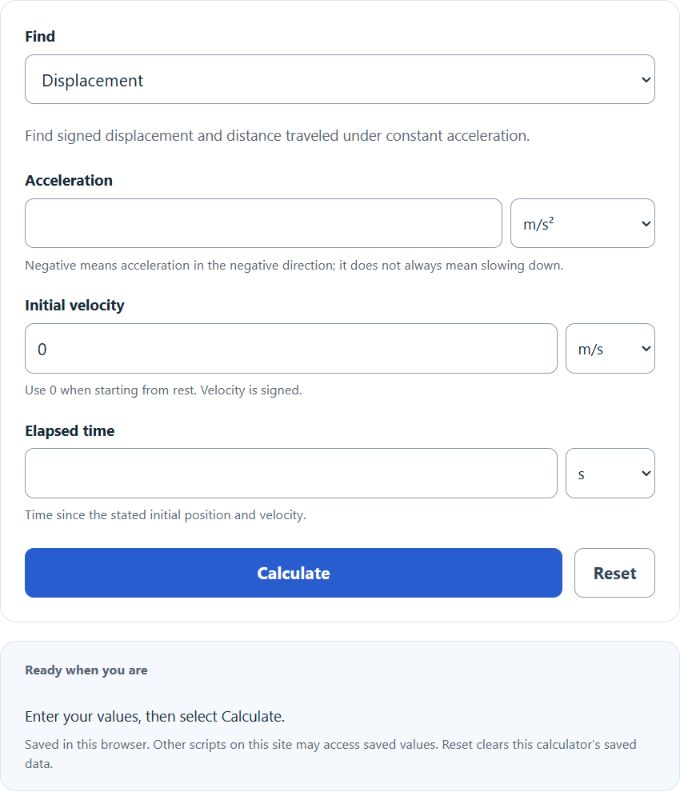
Calculate displacement, acceleration, initial velocity or elapsed time from three inputs under constant acceleration. Distance traveled is also shown, including motion that reverses direction.
- All Physics Calculators
- Mechanics and Physics Unit Converters
- Initial Velocity Calculator
- Acceleration Calculator
- Final Velocity Calculator
- Acceleration to Velocity Calculator
- Acceleration to Force Calculator
- Velocity to Acceleration Calculator
| Calculator Operations | Required Inputs |
|---|---|
| Convert to Acceleration | Distance, Initial Velocity, Time |
| Convert to Initial Velocity | Distance, Acceleration, Time |
| Convert to Time | Acceleration, Initial Velocity, Distance |
| Convert to Distance | Initial Velocity, Acceleration, Time |
Acceleration to Distance Formula
The following formula gives signed displacement from constant acceleration, initial velocity and elapsed time. Distance traveled equals the magnitude of displacement only when the motion does not reverse direction.
- Where D is the signed displacement (change in position)
- v is the initial velocity
- a is the acceleration
- t is the time.
To calculate displacement under constant acceleration, multiply initial velocity by elapsed time, then add one-half of acceleration times time squared. Use consistent units and one positive direction for all signed quantities.
Acceleration to Distance Conversion
For constant acceleration, displacement is initial velocity times elapsed time plus one-half of acceleration times time squared. An average acceleration alone does not generally determine displacement when acceleration varies. Negative acceleration denotes direction; it slows motion only when it opposes velocity.
Acceleration to Distance Example
How to calculate distance from acceleration?
- First, determine the initial velocity.
If the object is initially at rest, assume this value to be 0.
- Next, determine the acceleration.
Use the constant acceleration throughout the modeled interval.
- Next, determine the total time.
Calculate the total time of motion.
- Finally, calculate the distance.
Calculate signed displacement using the equation above. If motion reverses, add the path lengths before and after the turn to find distance traveled.
FAQ
For constant acceleration, D = v*t + 1/2*a*t^2 gives signed displacement, where v is initial velocity, t is elapsed time and a is acceleration. Distance traveled sums path lengths; it can exceed the magnitude of displacement if direction reverses.