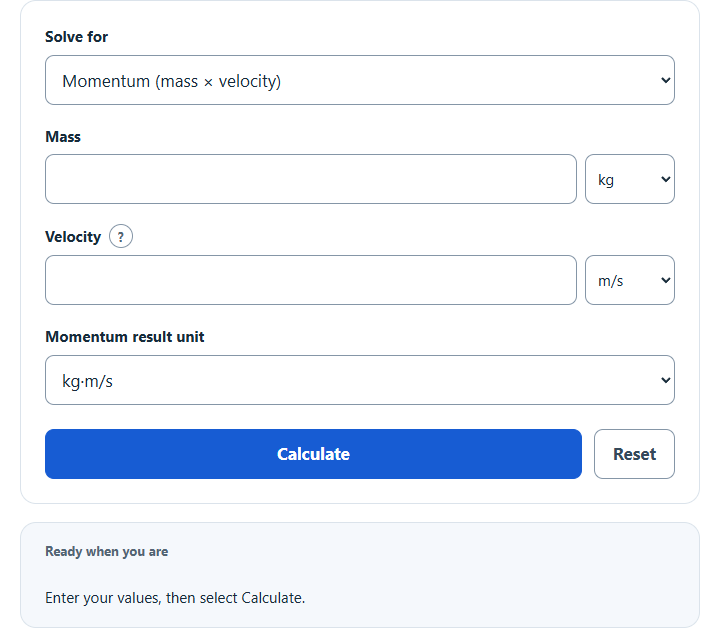
Calculate momentum as mass times velocity (p = mv), or find velocity from mass and momentum, kinetic energy or impulse, in metric or US units.
- All Physics Calculators
- Mechanics and Physics Unit Converters
- All Velocity Calculators
- Acceleration to Velocity Calculator
- Velocity to Force Calculator
Mass to Velocity Formula
The following classical equation calculates signed velocity from mass and momentum; mass alone does not determine velocity.
- Where V is the velocity (m/s)
- p is the momentum (kg*m/s)
- m is the mass (kg)
To calculate velocity from mass, you must know the value of the momentum since momentum relates velocity and mass. Once you know the momentum, simply divide by the mass to get the velocity.
| Meters per Second (m/s) | Feet per Second (ft/s) |
|---|---|
| 0.1 | 0.328 |
| 0.5 | 1.640 |
| 1 | 3.281 |
| 1.5 | 4.921 |
| 2 | 6.562 |
| 3 | 9.843 |
| 5 | 16.404 |
| 7.5 | 24.606 |
| 10 | 32.808 |
| 12 | 39.370 |
| 15 | 49.213 |
| 20 | 65.617 |
| 25 | 82.021 |
| 30 | 98.425 |
| 35 | 114.829 |
| 40 | 131.234 |
| 45 | 147.638 |
| 50 | 164.042 |
| 60 | 196.850 |
| 100 | 328.084 |
| *Since 1 ft = 0.3048 m exactly, 1 m/s = 1/0.3048 ft/s ≈ 3.28084 ft/s. Displayed table values are rounded. | |
How to Calculate Velocity from Mass?
Example Problem:
The following example outlines the steps and information needed to calculate classical velocity from mass and momentum.
First, determine the momentum. In this example, the momentum is found to be 500 kg-m/s.
Next, determine the mass. For this problem, the mass is found to be 10 kg.
Finally, calculate the velocity from mass using the formula above:
V = p / m
V = 500 / 10
V = 50 m/s