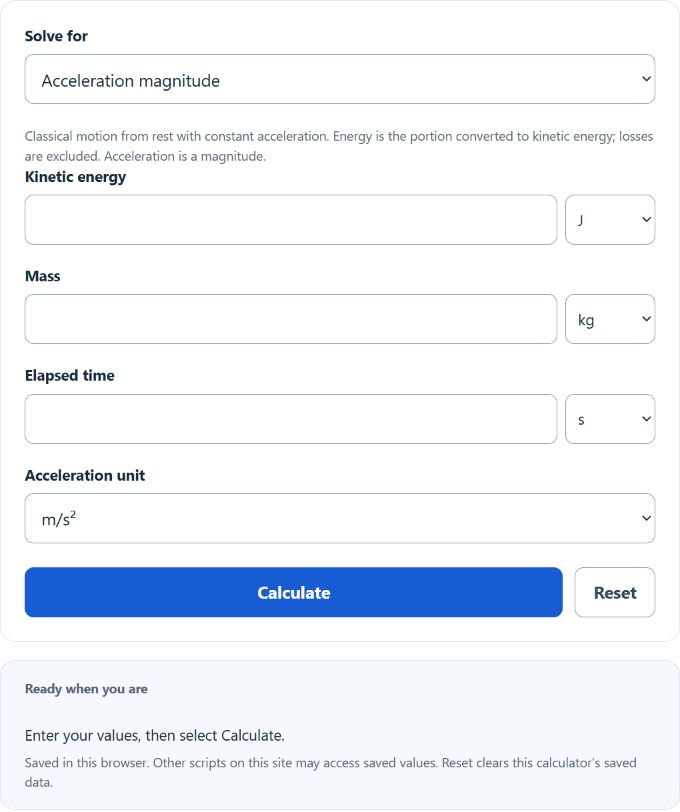
Calculate the missing value for joules, mass, time, or acceleration from the other three inputs with unit conversions and detailed steps.
- All Physics Calculators
- All Acceleration Calculators
- Power to Acceleration Calculator
- Thrust To Acceleration Calculator
- Joules to G Force Calculator
Joules to Acceleration Formula
This calculator estimates acceleration from energy, mass, and time by assuming the object starts from rest and the input energy is converted into kinetic energy during a period of uniform acceleration.
Note: joules and acceleration are not equivalent units by themselves. The relationship only becomes meaningful when mass and time are included in the model.
An equivalent form is:
Variable Definitions
| Variable | Meaning | Typical Unit |
|---|---|---|
| E | Energy transferred into motion | J |
| m | Mass of the object | kg |
| t | Time over which the acceleration occurs | s |
| a | Acceleration produced over that time interval | m/s² |
| v | Final speed reached from rest | m/s |
How the Equation Is Built
Start with kinetic energy and substitute velocity as acceleration multiplied by time. This connects energy input to the acceleration required to produce that motion.
How to Use the Calculator
- Select the quantity to solve for, then enter the other three known values. To find acceleration, enter energy, mass, and time.
- Use consistent units. Energy should be in joules, mass in kilograms, and time in seconds unless the calculator handles the conversion for you.
- Interpret the result as the average constant acceleration needed to convert that energy into motion over the entered time.
Example
If 400 J of energy is transferred to a 200 kg object over 100 s, the acceleration is:
In that same case, the final speed reached from rest is:
Rearranged Forms
If you know any three variables, the relationship can be rearranged to solve for the fourth:
How Each Input Affects the Result
- Increasing energy raises acceleration, but by a square-root relationship rather than a one-to-one increase.
- Increasing mass lowers acceleration because more energy is needed to move a heavier object.
- Increasing time lowers acceleration directly. For the same energy and mass, doubling the time cuts the acceleration in half.
When This Calculator Applies
- The object starts from rest.
- Acceleration is approximately constant during the time interval.
- The entered energy is the energy actually delivered to the object’s motion.
- Losses from friction, drag, heat, sound, or deformation are small enough to ignore.
Common Input Mistakes
- Entering weight instead of mass.
- Mixing seconds with minutes or hours without converting.
- Using total available energy instead of the portion transferred into kinetic energy.
- Applying the equation to cases with nonzero starting velocity or strongly changing acceleration.