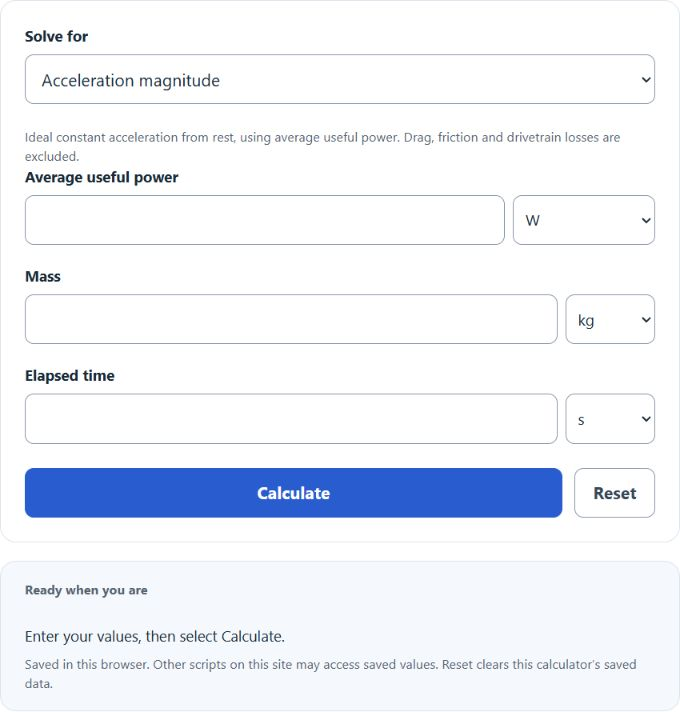
Calculate power, mass, time, or acceleration from the others using P = ½·m·a²·t for constant acceleration from rest, with unit conversions.
- All Acceleration Calculators
- Velocity to Acceleration Calculator
- All Physics Calculators
- Joules to Acceleration Calculator
- Power To Torque Calculator
Power to Acceleration Formula
This calculator estimates acceleration from average power when an object starts from rest and speeds up at a constant rate over a known time interval. It is most useful for quick engineering estimates, physics homework, and idealized motion problems where drivetrain losses, drag, and friction are not the main focus.
For that specific case, acceleration is found with:
The same relationship comes from the average-power form:
| Symbol | Meaning | Common SI Unit |
|---|---|---|
| a | Acceleration | m/s² |
| P | Average power delivered during the acceleration interval | W |
| m | Mass being accelerated | kg |
| t | Elapsed time of the acceleration | s |
What This Formula Means
Power measures how quickly energy is transferred. If a mass starts from rest, the supplied energy becomes kinetic energy. Over a fixed time, more average power produces more acceleration, while greater mass or a longer acceleration interval reduces the acceleration predicted by this ideal model.
- Higher power increases acceleration.
- Higher mass decreases acceleration.
- Longer time decreases the average acceleration required for the same power input.
Rearranged Forms
Because the calculator can solve for any missing variable, the same relationship can be rearranged as needed:
How to Use the Calculator
- Select the quantity to solve, then enter the three known values: average useful power, mass, elapsed time, or acceleration magnitude.
- Select the correct unit for each input. The calculator accepts power in watts, kilowatts, or horsepower; mass in kilograms, grams, or pounds; and time in seconds, minutes, or hours.
- Click Calculate to solve for the selected quantity.
- Interpret the result as an ideal average-motion estimate, not a guaranteed real-world performance value.
Example
If average power is 500 W, mass is 12 kg, and the acceleration lasts 5 s, then:
That means the object would need an acceleration of about 4.08 m/s² for the average power over that 5-second interval to be 500 W under the constant-acceleration-from-rest assumption.
Average Power vs. Instantaneous Power
This calculator uses average power over time. That is different from instantaneous power at a specific speed. Instantaneous power is related to force and velocity by:
That expression depends on the current velocity, so it changes during motion. The calculator on this page instead uses the average-energy approach for motion beginning at rest, which is why time appears directly in the equation.
When the Calculator Is a Good Fit
- Physics and engineering estimates involving ideal motion
- Checking whether a given power level is reasonable for a target acceleration
- Comparing how acceleration changes as mass or time changes
- Solving classroom problems involving kinetic energy and power
Important Assumptions
- The object starts from rest.
- Acceleration is treated as constant during the time interval.
- The input power is the average useful power delivered to the mass.
- Losses such as friction, rolling resistance, aerodynamic drag, heat, and drivetrain inefficiency are ignored.
If those assumptions are not true, the result should be treated as an approximation. In real systems, the actual acceleration is often lower than the ideal estimate because some power is lost before it becomes motion.
Units and Output
The calculator commonly returns acceleration in m/s², and also shows ft/s². For the most reliable results, make sure power, mass, and time reflect the same physical system. For example, if you use motor or engine power, it is better to use the power actually reaching the moving mass rather than only the rated input power.
Practical Notes
- If you double the power while keeping mass and time fixed, acceleration increases, but not by a factor of two because the equation uses a square root.
- If mass increases substantially, acceleration drops quickly for the same power and time.
- If you are analyzing vehicles, this model is best for simplified estimates rather than full performance simulation.
- If you already know the force and current speed, an instantaneous-power approach may be more appropriate than this average-power calculator.