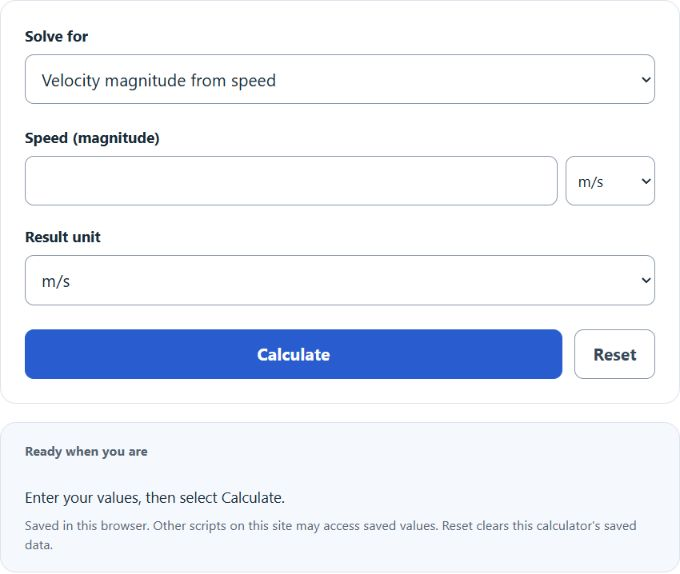
Convert speed to velocity magnitude across m/s, km/h, mph, and ft/s, or calculate north and east velocity components from speed and heading.
- All Physics Calculators
- All Velocity Calculators
- Constant Velocity Calculator
- Displacement to Velocity Calculator
Speed to Velocity Formula
Speed is the magnitude of velocity. To fully specify a velocity, you also need a direction.
- Where S is the speed (a scalar magnitude)
- |v⃗| is the magnitude of the velocity vector (i.e., the speed)
In everyday language, “speed” and “velocity” are sometimes used interchangeably, but in physics they are different: speed has no direction, while velocity includes direction.
Use the unit converter to switch between units of speed (or velocity magnitude).
| Speed (mph) | Equivalent speed (km/h) |
|---|---|
| 1 | 1.609 |
| 3 | 4.828 |
| 5 | 8.047 |
| 10 | 16.093 |
| 15 | 24.140 |
| 20 | 32.187 |
| 25 | 40.234 |
| 30 | 48.280 |
| 35 | 56.327 |
| 40 | 64.374 |
| 45 | 72.420 |
| 50 | 80.467 |
| 55 | 88.514 |
| 60 | 96.561 |
| 65 | 104.607 |
| 70 | 112.654 |
| 75 | 120.701 |
| 80 | 128.748 |
| 90 | 144.841 |
| 100 | 160.934 |
| Conversion factor: 1 mph = 1.609344 km/h. Values rounded to three decimals. | |
How to Calculate Velocity from Speed?
Example Problem:
The following example outlines the steps and information needed to state a velocity when a speed is known.
First, determine the speed. In this example, the speed is found to be 500 ft/s.
Next, choose the direction of motion (because velocity includes direction). For example, if the object is moving east at that speed, the velocity is 500 ft/s east. Without a direction, you can only state the magnitude of the velocity (500 ft/s).