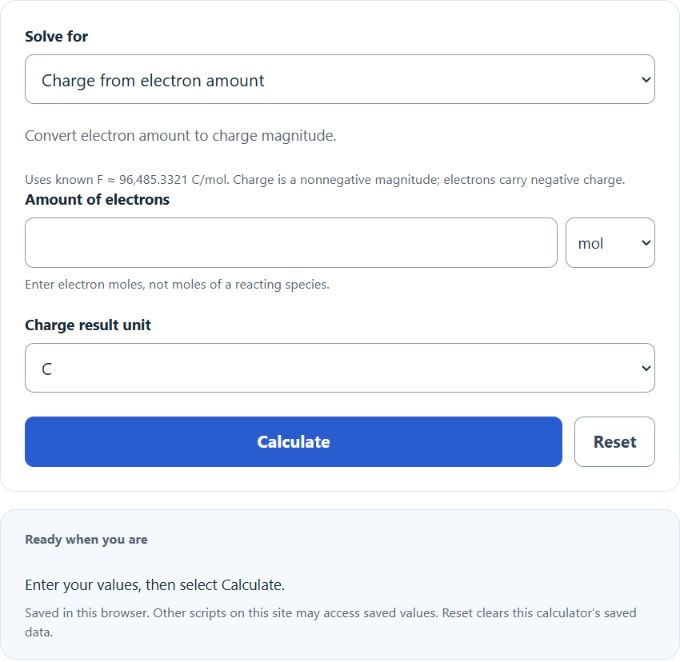
Calculate charge from moles of electrons or moles from total charge using Faraday’s constant, with C, mC, kC, mol, and mmol units.
Related Calculators
- Mole To Equivalent Calculator
- Moles To Ions Calculator
- Mass To Moles Calculator
- Oxidation Number Calculator
- All Chemistry Calculators
Faraday Constant Formula
Faraday’s constant relates charge magnitude to electron amount. This calculator uses the known constant to find Q = nF or n = Q/F:
Variables:
- F is the Faraday constant (C/mol)
- Q is the nonnegative charge magnitude (coulombs)
- n is the moles of electrons
For nonzero electron amount, F = Q/n. In the SI, F = Nₐe = 96485.3321233100184 C/mol exactly; the calculator converts charge and electron amount using this known value.
What is the Faraday Constant?
The Faraday constant, often denoted by the symbol F, is the magnitude of the electric charge carried by one mole of electrons. It is named after the English scientist Michael Faraday and is approximately equal to 96,485 coulombs per mole. This constant is widely used in electrochemistry to relate the amount of electric charge in coulombs to the amount of substance in moles.
How to Use the Faraday Constant?
The following steps outline how to convert charge and electron amount using the Faraday constant.
- First, choose whether you know charge magnitude Q or electron amount n.
- Next, enter that value and its unit. For a reacting species, first account for the number of electrons transferred per species.
- Use Q = nF or n = Q/F, with F ≈ 96485.3321 C/mol.
- Finally, calculate charge magnitude in C, mC or kC, or electron amount in mol or mmol.
- After inserting the variables and calculating the result, check your answer with the calculator above.
Example Problem:
Use the following variables as an example problem to test your knowledge.
Total charge magnitude (Q) ≈ 96485.3321 coulombs
Moles of electrons (n) = 1 mole