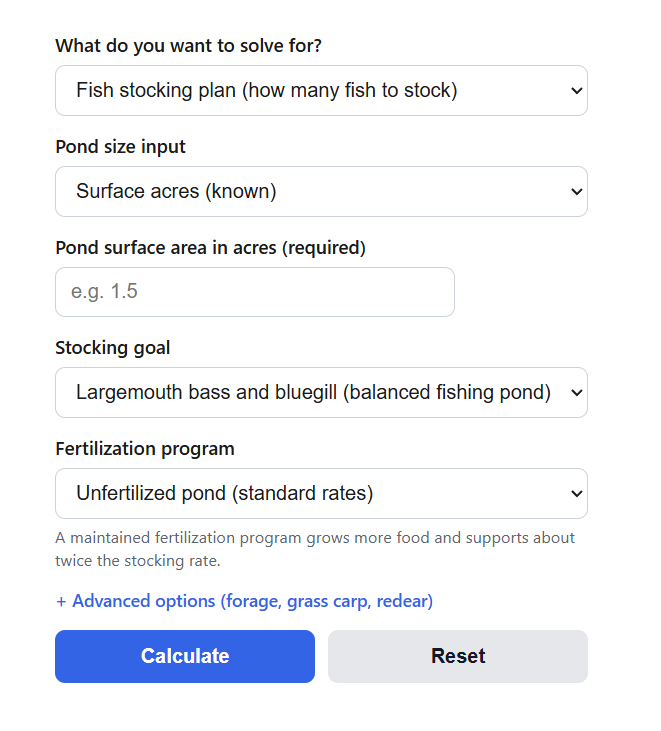
Calculate how many bass, bluegill, catfish, redear, minnows, and grass carp to stock in your farm pond from surface acres or pond dimensions, with fertilized and unfertilized rates.
Farm Pond Fish Stocking Formula
N = A * R
- N is the number of fish to stock for a given species
- A is the pond surface area in acres
- R is the recommended stocking rate for that species in fish per acre
If you do not know your pond’s acreage, the calculator estimates it from surface dimensions:
A = (L * W) / 43,560
- A is the surface area in acres
- L is the pond length in feet
- W is the pond width in feet
- 43,560 is the number of square feet in one acre (a round pond uses A = pi * (D/2)^2 / 43,560, where D is the diameter in feet)
The calculator applies these formulas by stocking goal. The bass and bluegill mode multiplies your acreage by the standard rates for bluegill, largemouth bass, and optional channel catfish, and doubles every rate if you run a fertilization program. The catfish-only mode uses a higher per-acre rate when you feed daily, since supplemental feed supports more fish. The hybrid bluegill mode uses rates suited to ponds under about an acre. The pond size mode skips the stocking math and returns surface acres, square feet, and, if you enter an average depth, volume in acre-feet and gallons, which is useful for fertilizer, herbicide, and pump sizing.
Recommended Stocking Rates and Order
The rates below follow standard state extension recommendations for new warm-water ponds of about one acre or larger. Fertilized ponds grow more plankton and natural food, so they support roughly double the stocking rate.
| Species (size) | Unfertilized (per acre) | Fertilized (per acre) |
|---|---|---|
| Bluegill, or 70/30 bluegill and redear (2-3 in) | 500 | 1,000 |
| Largemouth bass (2-4 in) | 50 | 100 |
| Channel catfish, optional (6-8 in) | 50 | 100 |
| Channel catfish only pond | 100 | up to 300 with daily feeding |
| Fathead minnows (forage) | 3 lb | 3 lb |
| Triploid grass carp (8+ in) | 5 (3 if over 10 acres) | 5 (3 if over 10 acres) |
Stocking order matters as much as the numbers. Bass stocked too early run out of food, and bream stocked too late get eaten before they spawn. Follow this sequence for a new pond:
| Step | When | What to stock and why |
|---|---|---|
| 1 | Fall or winter, pond at least half full and filling | Bluegill, redear, fathead minnows, catfish, and grass carp. These fish spawn the following spring and build the forage base. |
| 2 | Following spring | Largemouth bass, timed so newly hatched bream and minnows feed the fingerling bass. Keep the bream-to-bass ratio near 10:1. |
| 3 | Later years | Do not restock bass or bream. Restock catfish (8-10 in so bass cannot eat them) after harvesting about half the originals, and replace grass carp every 5 to 7 years as they lose effectiveness. |
Example Problems
Example 1: You have a 3 acre unfertilized pond and want a balanced bass and bluegill fishery with catfish, minnows, and grass carp. Multiply each rate by 3 acres: 500 x 3 = 1,500 bluegill, 50 x 3 = 150 largemouth bass, 50 x 3 = 150 channel catfish, 3 x 3 = 9 pounds of fathead minnows, and 5 x 3 = 15 grass carp. Stock everything except the bass in fall or winter, then add the 150 bass the next spring.
Example 2: You want a catfish-only pond and only know the dimensions: 150 feet long by 145 feet wide. Area = (150 x 145) / 43,560 = 21,750 / 43,560 = 0.50 acres. Without regular feeding, stock 100 x 0.50 = 50 channel catfish. If you commit to daily feeding, the pond supports up to 300 x 0.50 = 150 catfish.
Frequently Asked Questions
Why can’t I stock bass and bluegill at the same time?
Bass fingerlings need a steady supply of food small enough to eat. Bluegill stocked in fall spawn the following spring, and that first wave of fry arrives right when spring-stocked bass fingerlings need it. Stocking both together leaves the bass without enough forage, which produces thin, slow-growing bass and can let bluegill overpopulate and stunt. The 10:1 bream-to-bass ratio keeps predator demand matched to prey supply.
Do I need to restock my pond every year?
No. A correctly stocked bass and bluegill pond sustains itself through natural spawning, and adding more fish year after year is a common cause of overcrowding and stunted fish. The exceptions are channel catfish, which usually do not reproduce well in ponds and should be restocked with 8 to 10 inch fish after you harvest about half of them, and grass carp, which should be replaced every 5 to 7 years.
How many fish can a small pond under one acre hold?
Small ponds hold proportionally fewer fish, and largemouth bass are hard to keep balanced in ponds under about an acre. A better plan is the hybrid bluegill and catfish option: about 750 hybrid bluegill and 50 channel catfish per acre, scaled to your fraction of an acre. Hybrid bluegill grow fast, bite readily, and produce few offspring, so the population stays under control in a small pond.