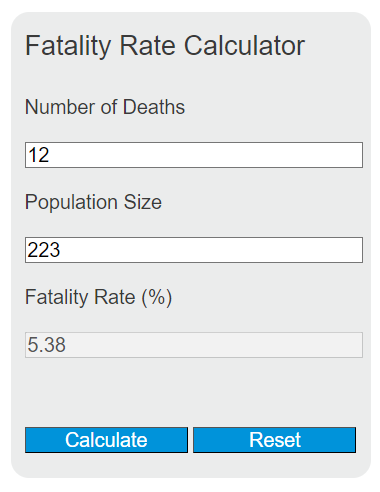
Calculate case fatality, mortality, infant and workforce fatality rates from deaths, cases, births, hours worked, and population size.
Related Calculators
- R Naught Calculator
- Positivity Rate Calculator
- Infection Rate Calculator
- Attack Rate Calculator
- All Health and Medical Calculators
Fatality Rate Formulas (Population, Case, and Workforce)
“Fatality rate” is used in different ways. Depending on context, one of the following formulas may be appropriate:
Variables:
- D is the number of deaths in the population during the period
- P is the population size (often the mid-period/average population) for that period
- N is the rate base (e.g., 1,000; 100,000; 1,000,000)
- Dc is the number of deaths among cases
- C is the total number of cases
- Dw is the number of fatal work injuries
- H is the total hours worked during the period (the factor 200,000,000 = 100,000 FTE-years × 2,000 hours per FTE-year)
Dividing deaths by the total population produces a population-based mortality measure (often reported “per 100,000” for a stated period and sometimes annualized). Dividing deaths by cases produces a case fatality rate (CFR), which is commonly what “fatality rate” refers to in outbreak and clinical settings.
What is a Fatality Rate?
A fatality rate most commonly refers to the case fatality rate (CFR): the percentage of identified cases (people with the disease/condition or exposed in an incident) who die from it over a defined period. In other contexts, people use “fatality rate” to mean a population-based death rate/proportion (deaths divided by the total population), which is a mortality measure and is typically reported per 1,000 or per 100,000 for a specified time period.
How to Calculate Fatality Rate?
The following steps outline how to calculate the measure you need:
- Decide which measure you want: a population-based death measure, a case fatality rate (CFR), or a workforce fatality rate.
- For a population-based measure, determine deaths (D), population size (P), and the time period (so the result can be interpreted “for that period” and optionally annualized).
- Compute a population death proportion as (D / P) × 100, or a population death rate as (D / P) × N for a chosen base (e.g., per 100,000).
- For CFR, determine deaths among cases (Dc) and total cases (C), then compute (Dc / C) × 100.
- For workforce fatality rate, determine fatal work injuries (Dw) and total hours worked (H), then compute (Dw / H) × 200,000,000 per 100,000 FTE worker-years.
- After inserting the variables and calculating the result, check your answer with the calculator above.
Example Problem:
Use the following variables as an example problem to test your knowledge.
Number of deaths (D) = 50
Population size (P) = 10,000
Population death proportion = (50 / 10,000) × 100 = 0.5% (equivalently, 500 per 100,000 for the period).