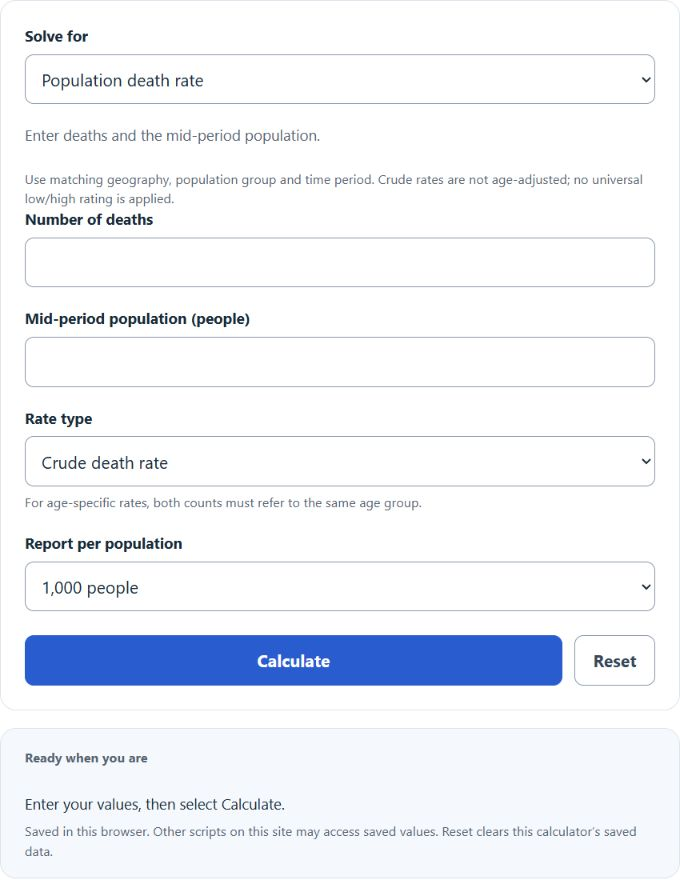
Calculate crude, infant, neonatal, postneonatal, and maternal mortality rates, plus proportional mortality ratio from deaths, births, and population.
- All Statistics Calculators
- All Rate Calculators
- Mortality Rate Calculator
- Crime Rate Calculator
- Rate Per 1000 Calculator
- Homicide Rate Calculator
Crude Death Rate Formula
Select the calculation type; each type uses the corresponding denominator below.
Population death rate mode (crude, cause-specific, or age-specific):
- D = number of deaths in the period
- P = mid-period population at risk
- K = rate base (1,000, 10,000, or 100,000)
Use the same time window for both D and P. For a cause-specific rate, D is deaths from that cause and P is the full population. For an age-specific rate, D and P both refer to the chosen age group.
Infant/maternal mode:
- Di = infant deaths under 1 year (or neonatal/postneonatal deaths)
- Dm = deaths related to or aggravated by pregnancy or its management during pregnancy or within 42 days after it ends, excluding accidental or incidental causes
- B = live births in the same period
The denominator is live births, not population. Maternal mortality uses a base of 100,000 by convention. Neonatal deaths cover 0 to 27 days; postneonatal cover 28 to 364 days.
Proportionate mortality mode (proportional mortality):
- Dc = deaths from the selected cause
- Dt = total deaths from all causes
This is a share of deaths, not a risk. A high PMR can occur when a cause is common or when other causes are rare.
Population death rate mode divides deaths by the mid-period population. Infant/maternal mode uses live births and the standard base unless overridden. Proportionate mortality mode reports the cause share of all deaths. Results apply to the entered period and are not automatically annualized.
Reference Tables
Use the denominator and reporting base appropriate to the measure. A crude rate alone does not justify a universal low, moderate, or high health-risk rating.
| Rate | Standard Base | Denominator |
|---|---|---|
| Crude death rate | per 1,000 | Mid-year population |
| Cause-specific death rate | per 100,000 | Mid-year population |
| Age-specific death rate | per 1,000 | Population in age group |
| Infant mortality rate | per 1,000 | Live births |
| Neonatal mortality rate | per 1,000 | Live births |
| Maternal mortality ratio | per 100,000 | Live births |
| Proportional mortality | percent | Total deaths |
Worked Examples and FAQ
Example 1: Crude death rate. A town records 850 deaths in a year with a mid-year population of 100,000. Rate = 850 / 100,000 × 1,000 = 8.5 per 1,000.
Example 2: Infant mortality rate. A district has 42 infant deaths and 12,000 live births. IMR = 42 / 12,000 × 1,000 = 3.5 per 1,000 live births.
Example 3: Proportional mortality. 25 deaths from one cause out of 850 total deaths. PMR = 25 / 850 × 100 = 2.94%.
Why is the crude death rate called “crude”? It does not adjust for age structure. A country with many older people will have a higher crude rate than a younger country even if health is identical at every age. Use age-standardized rates to compare populations fairly.
What population should I enter? Use the mid-period population, usually mid-year. For short studies, an average of the start and end populations works.
Why does maternal mortality use a base of 100,000? Maternal deaths are rare relative to live births. A larger base produces a whole number that is easier to read and compare.
Can the cause-specific rate be higher than the crude rate? No. Cause-specific deaths are a subset of all deaths, so the cause-specific rate is always lower than or equal to the crude rate when both use the same base.
Is proportional mortality the same as a death rate? No. PMR shows the share of deaths attributed to a cause. It does not measure risk in the population. Two areas can share the same PMR for a disease while having very different actual death rates.