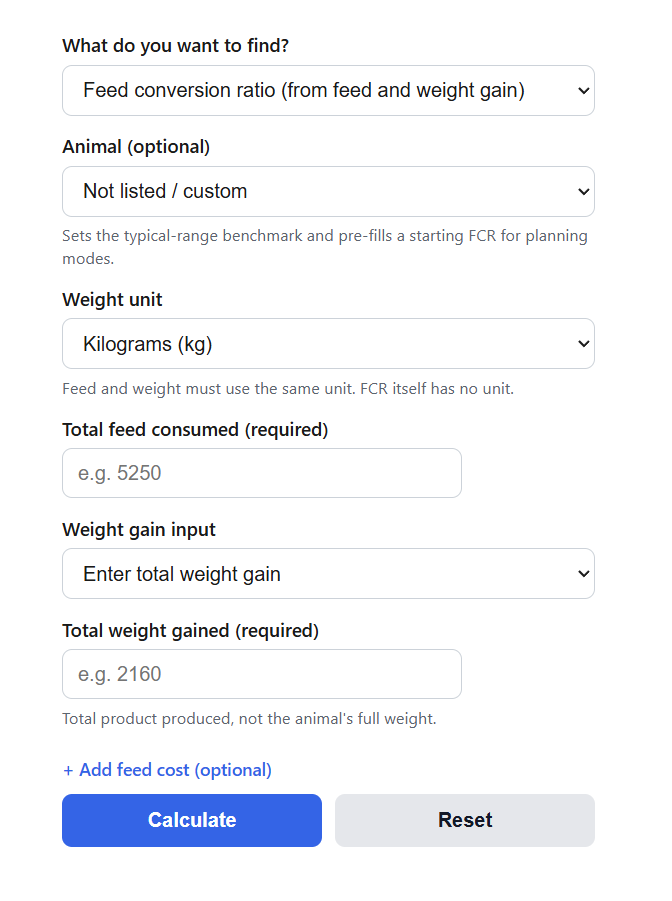
Calculate your feed conversion ratio (FCR) from total feed and weight gain, benchmark it against typical values for your animal, and plan feed needs or expected gain.
Feed Conversion Ratio Formula
The core formula divides how much feed an animal ate by how much product it produced over the same period:
FCR = Total Feed Consumed / Total Weight Gained
The calculator also runs two planning formulas. To find how much feed you need for a target amount of gain:
Feed Needed = Target Weight Gain * Expected FCR
To find how much gain a fixed amount of feed should produce:
Expected Weight Gain = Feed Available / Expected FCR
Two secondary outputs come from the same numbers. Feed efficiency is the inverse of FCR, and feed cost per unit of gain scales FCR by the price of feed:
Feed Efficiency (%) = 100 / FCR
 Feed Cost per Unit Gain = FCR * Feed Price per Unit
- Total Feed Consumed: the weight of all feed the animal or group ate during the period. Use feed actually eaten, not feed delivered, so wastage does not inflate the result.
- Total Weight Gained: final weight minus starting weight. This is the product produced, not the animal’s full body weight. For a group, multiply per-animal gain by the number of animals.
- Expected FCR: the conversion ratio you assume for planning. Selecting an animal fills in a typical value you can override.
- Feed Efficiency: how much gain you get from one unit of feed, shown as a percentage. Higher is better, the opposite direction from FCR.
- Feed Price per Unit: the cost of one unit of feed in the same weight unit you selected. It converts a ratio into a per-unit and total cost.
Feed and weight must be in the same unit before you divide, because FCR is a pure ratio with no unit of its own. The calculator keeps both on the unit you pick so an FCR of 1.8 means 1.8 kg of feed per 1 kg of gain, or 1.8 lb per 1 lb, either way.
Typical FCR by Animal and a Feed Efficiency Reference
Use the first table to judge whether your result is normal for the species. A value below the range is efficient, and a value above it points to feed, health, or management problems.
| Animal | Typical FCR | Notes |
| Broiler chicken | 1.5 to 2.0 | Most efficient land animal |
| Layer hen (egg mass) | 2.0 to 2.5 | Feed per unit of egg mass |
| Pig / swine | 2.7 to 5.0 | Worsens with age |
| Sheep / goat | 4.0 to 8.0 | Varies with breed and feed |
| Beef cattle | 6.0 to 10.0 | Highest among land animals |
| Salmon (farmed) | 1.0 to 1.3 | Most efficient overall |
| Tilapia | 1.4 to 1.8 | Warm-water species |
| Catfish | 1.5 to 2.5 | Depends on system |
The second table converts any FCR into feed efficiency and into how much feed each 100 units of gain requires. It gives you a quick way to read the same result in three ways and to see how much feed you save as FCR drops.
| FCR | Feed efficiency | Feed per 100 units of gain |
| 1.3 | 76.9% | 130 units |
| 1.6 | 62.5% | 160 units |
| 1.8 | 55.6% | 180 units |
| 2.5 | 40.0% | 250 units |
| 4.0 | 25.0% | 400 units |
| 8.0 | 12.5% | 800 units |
The money angle follows directly. Because feed cost per unit of gain equals FCR times feed price, every 0.1 drop in FCR saves the price of 0.1 unit of feed for every unit of product you sell. At a feed price of 0.40 per kg, improving a broiler flock from 1.8 to 1.6 cuts feed cost from 0.72 to 0.64 per kg of meat, which is 80 saved for every 1,000 kg produced.
Example Problems
Example 1: FCR for a broiler flock. A group of 1,000 broilers ate 5,250 kg of feed total. They started at 0.04 kg each and finished at 2.2 kg each. Total gain is (2.2 – 0.04) times 1,000, which is 2,160 kg. FCR is 5,250 divided by 2,160, which is 2.43. That sits above the 1.5 to 2.0 broiler range, so the flock has room to improve.
Example 2: Feed needed for a target. You want to grow 1,000 kg of pig weight and assume an FCR of 3.0. Feed needed is 1,000 times 3.0, which is 3,000 kg. If feed costs 0.35 per kg, the feed bill for that gain is 3,000 times 0.35, which is 1,050.
Frequently Asked Questions
What is a good feed conversion ratio? It depends entirely on the species. For broiler chickens an FCR below 1.8 is excellent and 1.8 to 2.0 is average. For beef cattle, 6.0 is good and 10.0 is on the high side. Farmed salmon can reach 1.0 to 1.3, which no land animal matches. Always compare your result to the range for that specific animal rather than to another species.
Should I use feed delivered or feed eaten? Use feed actually eaten. If you count feed that was spilled, spoiled, or left in the feeder, your FCR looks worse than the animal’s true performance. Weighing leftover feed and subtracting it gives a far more accurate ratio, which is why feeder design and storage matter to the number.
How is FCR different from feed efficiency? They are inverses of the same relationship. FCR tells you how much feed produces one unit of gain, so lower is better. Feed efficiency tells you how much gain comes from one unit of feed, shown as a percentage, so higher is better. An FCR of 2.0 is the same as 50 percent feed efficiency. The calculator shows both so you can read the result whichever way your operation prefers.