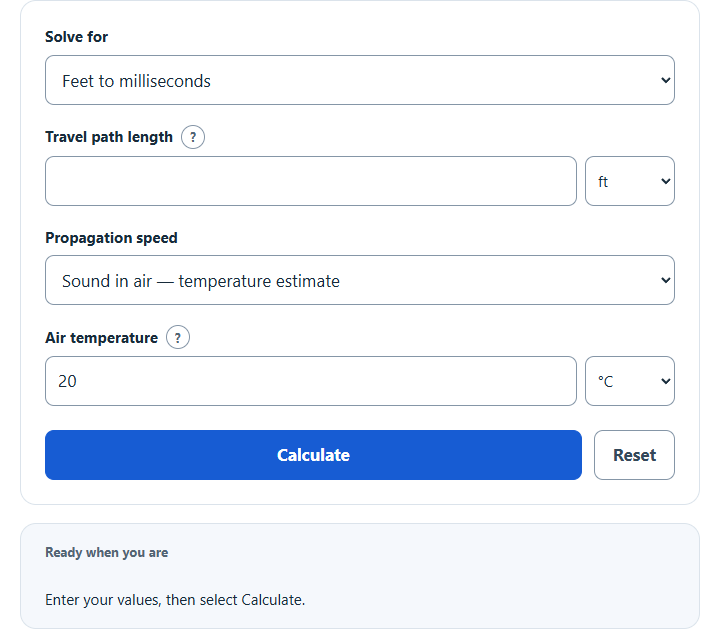
Convert feet to milliseconds of sound travel time for speaker delay, using air temperature in °C or °F or your own speed, or convert ms back to feet.
Calculator Functions
| Function | What it does | What it requires |
|---|---|---|
| Feet to milliseconds | Finds how long sound, or anything moving at a set speed, takes to cover a distance | Requires the travel path length and a propagation speed: sound in air at an entered temperature, or an entered speed |
| Milliseconds to feet | Finds the distance covered in a given time | Requires the travel time in milliseconds and a propagation speed: sound in air at an entered temperature, or an entered speed |
Feet and milliseconds measure different things, so the conversion needs a speed. The calculator starts with sound in dry air at 20 °C (68 °F), which fits speaker delay and echo timing, and accepts air temperatures from 0 to 40 °C (32 to 104 °F). The other setting takes a speed in ft/s, m/s, mph or km/h. Distance can be entered in feet or meters.
Feet to Milliseconds Formulas
| T | Travel time in milliseconds (ms) |
| D | Distance in feet. The calculator converts it to meters with 1 ft = 0.3048 m |
| S | Speed in feet per second, or in m/s when the distance is in meters |
Speed of Sound in Air
c is the speed of sound in dry air in m/s and TC is the air temperature in °C [1]. The speed of sound in a gas depends on the gas and its temperature, rising with the square root of absolute temperature [2], and this straight line is a close fit to that curve near room temperature. At 20 °C it gives 343.42 m/s, which is 1,126.7 ft/s, so sound takes 0.8875 ms to travel one foot.
Feet to milliseconds
For sound at 20 °C, 6 feet is (6 ÷ 1,126.7) × 1,000 = 5.325 ms and 100 feet is 88.754 ms. Colder air is slower: at 0 °C the same 100 feet takes 92.001 ms. With an entered speed of 50 ft/s, 500 feet takes (500 ÷ 50) × 1,000 = 10,000 ms.
| Distance (ft) | Sound travel time at 20 °C (ms) |
|---|---|
| 1 | 0.888 |
| 5 | 4.438 |
| 6 | 5.325 |
| 10 | 8.875 |
| 15 | 13.313 |
| 20 | 17.751 |
| 25 | 22.189 |
| 30 | 26.626 |
| 50 | 44.377 |
| 75 | 66.566 |
| 100 | 88.754 |
| 200 | 177.509 |
| 500 | 443.771 |
| 1,000 | 887.543 |
Milliseconds to feet
At 20 °C sound covers 1.1267 feet per millisecond, so 10 ms corresponds to 11.267 feet.
Limits of This Estimate
- The sound setting is a dry-air approximation for 0 to 40 °C. Humidity and wind are not included.
- The result is one-way travel time. For an echo, the path is the full distance out and back.
- This is physical travel time only. Processing delay inside audio equipment is separate and adds to it.
- An entered speed is assumed constant over the whole path.
Sources
- North Carolina State University, Speed of Sound lab manual: speed of sound in dry air as 331.3 + 0.606 × temperature in °C
- NASA Glenn Research Center, Speed of Sound Interactive: dependence of the speed of sound on the gas and its absolute temperature