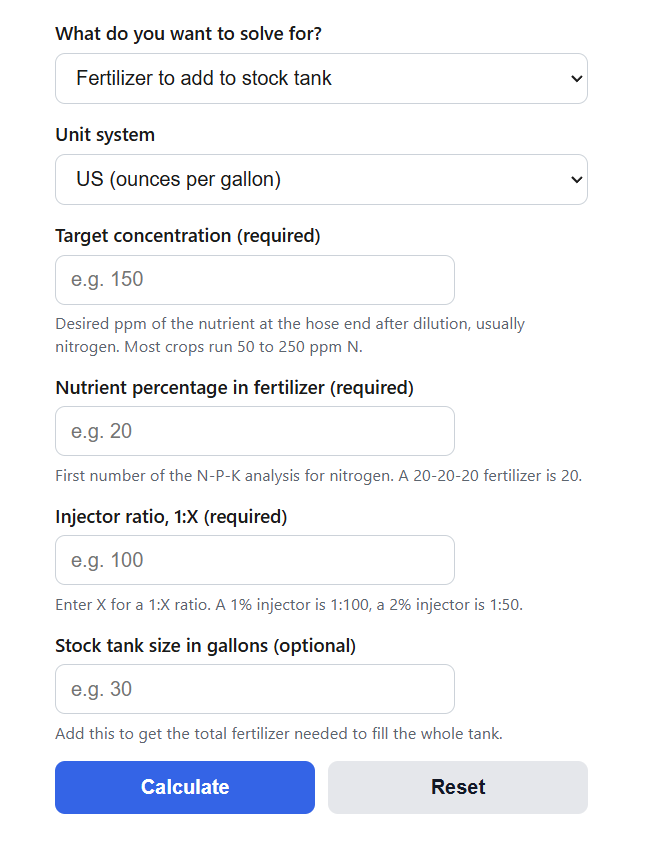
Calculate how much fertilizer to add to your injector stock tank from a target ppm, fertilizer analysis, and 1:X ratio, or verify your injector’s true ratio.
Fertilizer Injector Ratio Formula
OZ = (PPM * R) / (N * 75)
GL = (PPM * R) / (N * 10)
AR = VD / VS
- OZ is the ounces of water-soluble fertilizer to dissolve per gallon of stock solution
- GL is the grams of fertilizer to dissolve per liter of stock solution
- PPM is the target nutrient concentration at the hose end after dilution (mg/L)
- R is the X in a 1:X injector ratio (a 1:100 injector has R = 100)
- N is the nutrient percentage from the fertilizer label (20 for a 20-20-20 fertilizer)
- 75 is the standard constant relating 1 oz/gal of a fully soluble nutrient to about 7,500 ppm
- 10 is the metric constant relating 1 g/L to 1,000 ppm
- AR is the actual injector ratio measured during a calibration test
- VD is the volume of diluted output collected, and VS is the volume of stock solution drawn, both in the same units
The calculator uses these formulas in three modes. The stock mix mode solves the first formula (or its metric version) for the amount of fertilizer to dissolve in the stock tank, and multiplies by tank size to get the total batch weight. The delivered ppm mode rearranges the same formula to check what concentration an existing mix sends to your plants. The calibration mode divides the diluted output volume by the stock volume the injector actually drew, converts both to milliliters internally, and compares the measured ratio against the rated 1:X setting to flag drift beyond the accepted 5 percent tolerance.
Common Injector Ratios and Stock Strengths
This table converts the most common injector settings between ratio and percentage form and shows how much 20 percent nitrogen fertilizer each setting requires in the stock tank to deliver 100 ppm N at the hose end. Higher ratios need a stronger stock, which is why high-dilution injectors can push low-analysis fertilizers past their solubility limit.
| Injector ratio | Injection % | Stock is stronger by | oz/gal stock (100 ppm N, 20% N) | g/L stock (100 ppm N, 20% N) |
|---|---|---|---|---|
| 1:16 | 6.25% | 16x | 1.07 | 8.0 |
| 1:32 | 3.13% | 32x | 2.13 | 16.0 |
| 1:50 | 2% | 50x | 3.33 | 25.0 |
| 1:100 | 1% | 100x | 6.67 | 50.0 |
| 1:128 | 0.78% | 128x | 8.53 | 64.0 |
| 1:200 | 0.5% | 200x | 13.33 | 100.0 |
Interpreting a Calibration Test
After you run the calibration mode, use this table to decide what the measured deviation means. A negative deviation means the measured ratio is lower than rated (for example 1:92 on a 1:100 unit), so the injector draws more concentrate than expected and overfeeds. A positive deviation means it draws less and underfeeds.
| Deviation from rated ratio | What it means | Action |
|---|---|---|
| Within 2% | Injector is performing to spec | None; retest monthly during the season |
| 2% to 5% | Normal wear or minor pressure variation | Acceptable; note the drift and retest sooner |
| More than 5% overfeeding (negative) | Worn piston or seals letting extra concentrate through | Service the unit; reduce stock strength until fixed |
| More than 5% underfeeding (positive) | Clogged suction strainer, air leak, or kinked intake line | Clean the strainer and check fittings, then retest |
| Erratic between runs | Fluctuating water pressure or failing internal parts | Test at stable pressure; service if it persists |
Example Problems
Example 1: How much 20-20-20 for 150 ppm N through a 1:100 injector?
You want 150 ppm nitrogen at the hose end, your fertilizer is 20 percent nitrogen, your injector is set to 1:100, and your stock tank holds 30 gallons. Apply the formula: OZ = (150 * 100) / (20 * 75) = 15,000 / 1,500 = 10 oz per gallon of stock. For the full 30 gallon tank, you need 10 * 30 = 300 oz, which is 18.75 lb of fertilizer. The stock tank concentration is 15,000 ppm, and the injection percentage is 1 percent.
Example 2: Is the injector still drawing at its rated ratio?
You run a calibration test on an injector rated 1:100. You collect 10 gallons of diluted output (37,854 mL) and the injector draws 13.5 fluid ounces of stock (399.2 mL). The actual ratio is AR = 37,854 / 399.2 = 1:94.8. The deviation is (94.8 – 100) / 100 = -5.2 percent, just outside the 5 percent tolerance on the overfeeding side. The unit is pulling more concentrate than the dial claims, so plants receive a stronger feed than your mixing math assumes. Service or recalibrate the injector before mixing the next batch.
FAQ
What does a 1:100 injector ratio mean?
A 1:100 ratio means the injector delivers 1 part of concentrated stock solution for every 100 parts of finished water leaving the hose. Put differently, 1 gallon of stock produces 100 gallons of diluted feed water. Because of that dilution, the stock tank must be mixed 100 times stronger than the concentration you want the plants to receive. A 1:100 setting is the same as a 1 percent injection rate.
How do I convert an injector percentage to a ratio?
Divide 100 by the percentage. A 2 percent injector is 100 / 2 = 1:50, a 1 percent injector is 1:100, and a 0.5 percent injector is 1:200. Going the other way, divide 100 by the X in 1:X to get the percentage. Some injectors, such as many Dosatron models, display percentage on the dial while feed charts list ratios, so this conversion comes up constantly when matching a chart to your equipment.
Why does my EC meter reading not match the calculated ppm?
Three causes account for most mismatches. First, your source water already carries dissolved minerals, so its background EC adds to the fertilizer contribution; measure plain water first and subtract it. Second, TDS meters use different conversion scales (500, 640, or 700 ppm per mS/cm), so two meters can report different ppm numbers for the same solution. Third, the injector may have drifted from its rated ratio, which is exactly what the calibration mode of this calculator detects. Test the injector, not just the solution, when numbers refuse to line up.