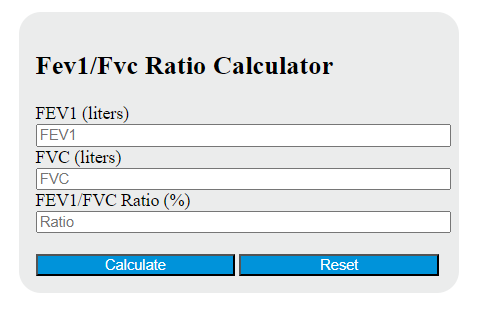
Calculate the FEV1/FVC ratio or solve for FEV1 or FVC from exactly two known values. Clinical interpretation requires the laboratory’s appropriate reference limit and test-quality review.
FEV1/FVC Ratio Formulas
The forward formula is FEV1/FVC ratio (%) = FEV1 ÷ FVC × 100. The same relationship can be rearranged to solve either volume: FEV1 = ratio as a fraction × FVC, and FVC = FEV1 ÷ ratio as a fraction. A percentage must be divided by 100 before it is used as a fraction, so 78.125% becomes 0.78125.
This calculator performs only those three algebraic operations. It requires exactly two known values and leaves the third field blank. The output shows the solved quantity and substitution without labeling a result normal, obstructive, or diagnostic. Clinical interpretation requires the laboratory’s reference equation, lower limit of normal, test-quality review, and the circumstances of testing.
Variables and Units
| Variable | Definition | Accepted format |
|---|---|---|
| FEV1 | Forced expiratory volume exhaled during the first second | Liters or milliliters |
| FVC | Forced vital capacity exhaled during the complete maneuver | Same unit selected for FEV1 |
| FEV1/FVC | FEV1 divided by FVC | Percent from greater than 0 to 100, or fraction from greater than 0 to 1 |
Because FEV1 is part of the volume represented by FVC, this educational calculator rejects a supplied or derived FEV1 greater than FVC. That guard can catch a swapped field, mixed unit, transcription error, or values copied from different testing columns. It does not attempt to repair a report. Use the same selected volume unit for both fields; converting 2.5 L to 2500 mL does not change the ratio when FVC is converted the same way.
What the Ratio Represents
Spirometry records flow and volume while a person inhales fully and then exhales as forcefully and completely as possible. FEV1 measures the portion exhaled in the first second. FVC measures the total forced volume for the accepted maneuver. Their ratio expresses how much of that forced vital capacity was expired during the first second.
The arithmetic is simple, but the measurements are effort-dependent and quality-dependent. Cough, hesitation, leak, glottic closure, early termination, variable effort, or failure to reach a satisfactory end of test can alter one or both values. Pulmonary laboratories assess acceptability and repeatability before selecting reported results. A calculator cannot determine whether those standards were met.
How to Use the FEV1/FVC Calculator
- Select liters or milliliters for the volume entries.
- Select percent or fraction for a known ratio.
- Enter exactly two values and leave the quantity you want to solve blank.
- Choose Calculate and check the displayed substitution against the source report.
- Use Reset before beginning a different example.
If all three fields are filled, the tool does not silently choose one to overwrite. If fewer than two are filled, there is not enough information. Values must be finite and greater than zero, and text such as “2.5 liters” is rejected so an unnoticed trailing label cannot be partly parsed as a number.
Worked Examples
Calculate the ratio
For FEV1 of 2.5 L and FVC of 3.2 L, divide 2.5 by 3.2 to obtain 0.78125. Multiply by 100 to display 78.125%. The same calculation with 2500 mL and 3200 mL gives the identical ratio because the equal unit factors cancel.
Solve for FEV1
With FVC of 3.2 L and ratio of 78.125%, first convert the percentage to 0.78125. Then multiply 0.78125 × 3.2 L to obtain FEV1 of 2.5 L. Enter the ratio as 78.125 with Percent selected, not as 0.78125 unless Fraction is selected.
Solve for FVC
With FEV1 of 2500 mL and ratio of 78.125%, calculate 2500 ÷ 0.78125 to obtain FVC of 3200 mL. If the desired display is liters, either convert the inputs before entering them or divide the milliliter result by 1000.
Ratio Versus FEV1 Percent Predicted
FEV1/FVC and FEV1 percent predicted answer different questions. The ratio compares two measurements from the forced maneuver. FEV1 percent predicted compares measured FEV1 with a reference-equation predicted FEV1: measured FEV1 ÷ predicted FEV1 × 100. A person can have a reduced ratio with an FEV1 percent predicted that is relatively preserved, or a ratio within its reference interval while FEV1 is reduced. Do not substitute one measure for the other.
How Clinicians Interpret FEV1/FVC
For general spirometric interpretation, ERS/ATS guidance uses an appropriate reference equation and its LLN or z-score rather than treating one percentage as universal. Expected ratios vary with age and other characteristics incorporated into the chosen reference set. A ratio may be below one person’s LLN and above another person’s LLN even when the displayed percentage is identical.
The fixed post-bronchodilator ratio of 0.70 has a specific case-definition role in the GOLD framework for COPD. That does not make 70% a universal boundary for every age, pre-bronchodilator result, disease, screening purpose, or laboratory. This page therefore owns the algebra only. Use the laboratory’s interpretive section or the separate LLN-based PFT interpretation calculator when the necessary report values are available.
Common Entry Errors
- Percent versus fraction: 80% equals 0.80. Select the format that matches the entry.
- Mixed volume units: 2.5 L divided by 3200 mL is wrong unless one value is converted.
- Swapped fields: FEV1 greater than FVC is rejected rather than interpreted.
- Wrong report column: do not combine a pre-bronchodilator value with a post-bronchodilator value unless that is the explicit calculation being studied.
- Rounded source values: a ratio recomputed from displayed volumes may differ slightly from a laboratory ratio calculated from higher-precision data.
When checking a published ratio, retain as many source digits as the report supplies and round only the final display. Reverse solving from a rounded ratio can return a volume that differs slightly from the original measurement. For example, rebuilding FEV1 from 78% instead of 78.125% necessarily loses information. That mathematical difference is not evidence that the spirometer or report is wrong. Use the laboratory’s reported values and interpretation as the clinical record.
Limitations and Next Steps
The result is mathematical, not a diagnosis or severity grade. It does not assess curve shape, bronchodilator response, lung volumes, gas transfer, symptoms, exposures, imaging, or changes over time. Review the test’s quality grade, the laboratory’s LLN and z-score, whether values are pre- or post-bronchodilator, and the clinical question. Discuss unexpected results with the ordering clinician or pulmonary laboratory.
Serial comparison also requires care. Equipment, calibration, coaching, medication timing, posture, acute illness, and the acceptability of each maneuver can influence the reported volumes. A numerical change is not automatically a clinically meaningful change. The interpreting professional can determine whether two studies are sufficiently comparable and whether the difference exceeds expected measurement variability.
Frequently Asked Questions
Is a ratio above 70% always normal?
No. General interpretation uses the appropriate laboratory LLN and testing context. This calculator intentionally does not apply a fixed cutoff.
Why does the recalculated ratio differ from my report?
The report may calculate from unrounded source data or select values according to laboratory rules. Small rounding differences are possible; larger differences should prompt a transcription and report-quality check.
Primary Sources
- ERS/ATS technical standard on interpretive strategies for routine lung function tests, 2022: doi:10.1183/13993003.01499-2021.
- ATS/ERS Standardization of Spirometry 2019 Update: doi:10.1164/rccm.201908-1590ST and full text.
- American Thoracic Society, Interpretive Strategies implementation materials.