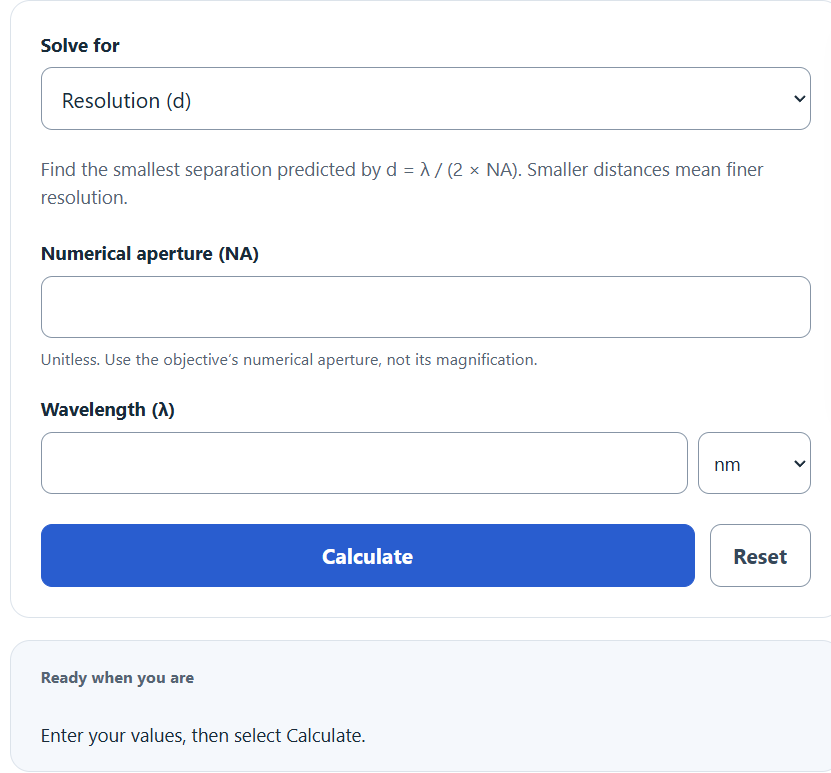
Calculate the missing value in the Abbe equation from numerical aperture, resolution, and wavelength using any two inputs in selectable units.
Related Calculators
- Mirror Equation Calculator
- Relative Permittivity Calculator
- Intensity Calculator
- Angle of Impact Calculator
- All Physics Calculators
Abbe Equation (Resolution) Formula
The Abbe equation estimates the smallest distance between two points that can still be resolved by an optical system. The calculator uses the standard resolution form:
Choose the value under Solve for. The calculator shows only the two known inputs and uses the corresponding rearranged form:
- d = resolution, or the minimum resolvable distance between two points
- λ = wavelength of light
- NA = numerical aperture, a unitless measure of light-gathering ability
If you enter numerical aperture and wavelength, the calculator solves for resolution. If you enter resolution and wavelength, it solves for numerical aperture. If you enter numerical aperture and resolution, it solves for wavelength. Length inputs are converted internally so that wavelength and resolution use compatible units before the formula is applied. Length results include equivalent units.
Common Wavelengths and Resolution Ranges
The Abbe equation shows that shorter wavelengths and larger numerical apertures produce smaller resolution values. A smaller value of d means better resolving ability.
| Light color or source | Typical wavelength | Resolution at NA = 1.40 |
|---|---|---|
| Violet light | 400 nm | 143 nm |
| Blue light | 450 nm | 161 nm |
| Green light | 550 nm | 196 nm |
| Red light | 650 nm | 232 nm |
| Numerical aperture | Typical use | Resolution with 550 nm light |
|---|---|---|
| 0.25 | Low-power objective | 1100 nm, or 1.10 μm |
| 0.65 | Dry objective | 423 nm |
| 0.95 | High-NA dry objective | 289 nm |
| 1.40 | Oil immersion objective | 196 nm |
Example Calculations
Example 1: Find resolution
You have green light with a wavelength of 550 nm and an objective with NA = 1.40.
The resolution is about 196 nm.
Example 2: Find numerical aperture
You want a resolution of 250 nm using light with a wavelength of 500 nm.
You need a numerical aperture of 1.00.
FAQ
Does a smaller resolution value mean better resolution?
Yes. In the Abbe equation, resolution d is the minimum distance between two points that can be distinguished. A smaller value means the optical system can separate points that are closer together.
Why is numerical aperture unitless?
Numerical aperture is based on refractive index and the angle of collected light. Since refractive index is unitless and the sine of an angle is unitless, NA has no length unit.
Should wavelength and resolution use the same units?
They must be compatible in the formula. The calculator converts wavelength and resolution units internally before solving. If you calculate by hand, use the same length unit for both values, such as nanometers for wavelength and nanometers for resolution.