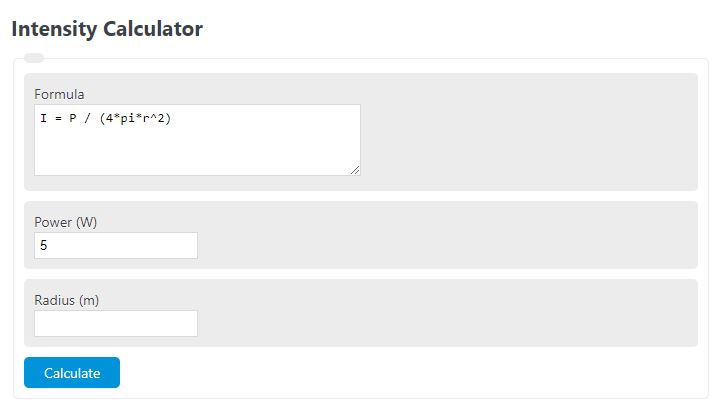
Calculate or reverse-solve intensity, power, area, and point-source distance with SI and imperial units, inverse-square comparisons, and sound intensity level conversion.
- All Physics Calculators
- Apparent Power Calculator
- Reactive Power Calculator
- Energy to Wavelength Calculator
- Relative Intensity Calculator
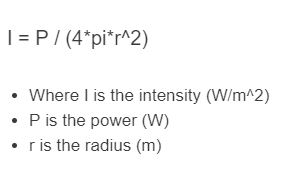
Intensity Formula
Intensity describes how much power is distributed across a given area. For a source that radiates uniformly in all directions, the power spreads over the surface of an expanding sphere, so the intensity falls as distance increases.
- I = intensity in watts per square meter (W/m²)
- P = total power of the wave or source in watts (W)
- r = distance from the source in meters (m)
This relationship is an application of spherical spreading: the same total power is shared over a larger and larger area as the radius grows.
Equivalent Forms
If you know any two variables, you can solve for the third.
| Unknown | Formula | Use When |
|---|---|---|
| Intensity | I = (P) / (4π r²) |
You know the source power and the distance from the source. |
| Power | P = 4π r² I |
You know the measured intensity at a known radius. |
| Radius | r = √((P) / (4π I)) |
You know the power and want the distance for a target intensity. |
Area Relationship
The formula comes from dividing power by the surface area of a sphere.
As the radius increases, the area grows very quickly, which is why intensity decreases rapidly with distance.
How to Use the Calculator
- Enter any two known values: intensity, power, or radius.
- Select the correct units for each field.
- Calculate the missing value.
- Check that the result is physically reasonable for the type of source you are analyzing.
For manual calculations, keep units consistent. Power should be in watts and radius should be in meters to obtain intensity in W/m².
Example Calculation
If a source emits 200 W and you are 0.5 m away, first determine the spherical area at that radius.
Now divide power by area.
The intensity is approximately 63.66 W/m².
Key Relationships to Remember
- If power doubles, intensity doubles.
- If radius doubles, intensity becomes one-fourth as large.
- If radius triples, intensity becomes one-ninth as large.
- Small changes in distance can produce large changes in intensity because of the square term.
When This Formula Applies
This calculator is most appropriate when the source can be approximated as radiating uniformly in all directions from a point-like location. That makes it useful for many basic physics problems involving sound, light, radiation, and other wave or energy-spreading situations.
It is less accurate for highly directional beams, focused sources, near-field measurements, or cases where absorption, reflection, or shielding significantly changes how the energy spreads.
FAQ
What does intensity measure?
Intensity measures the rate of energy transfer through a unit area. In practical terms, it tells you how concentrated the power is at a particular location.
Why does intensity decrease with distance?
Because the same total power is spread over a larger spherical surface as you move away from the source.
Is intensity the same as power?
No. Power is the total energy transferred per unit time, while intensity is that power distributed over area.
Can this be used for sound and light?
Yes, as long as the situation reasonably follows spherical spreading from the source.