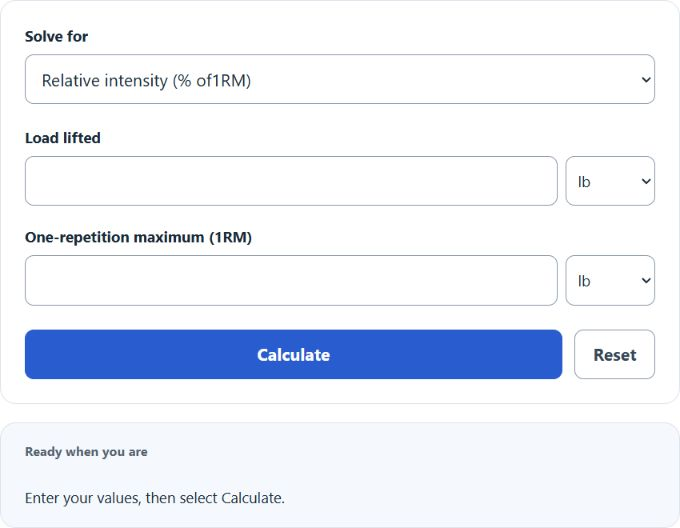
Calculate relative intensity from lifted weight and 1RM, or estimate load from reps and RPE using this page’s inherited heuristic chart in lb or kg. The chart is a rough comparison tool whose estimates vary by lift and lifter.
Relative Intensity Formula
Variables:
- RI is the relative intensity (percent of 1RM, %)
- W is the load (weight) lifted (same units as 1RM)
- 1RM is the one-repetition maximum (the maximum load you can lift for one rep)
To calculate relative intensity, divide the load you lifted by your 1RM and multiply by 100. (If you lift 80% of your 1RM, your relative intensity is 80%.)
How to Calculate Relative Intensity?
The following steps outline how to calculate the Relative Intensity.
- First, determine the load (weight) lifted, W.
- Next, determine your one-rep max (1RM) for the same lift (measured or estimated).
- Next, gather the formula from above: RI(%) = (W ÷ 1RM) × 100%.
- Finally, calculate the relative intensity.
- After inserting the variables and calculating the result, check your answer with the calculator above.
Example Problem :
Use the following variables as an example problem to test your knowledge.
weight lifted (W) = 50
one rep max (1RM) = 85
Relative Intensity = (50 ÷ 85) × 100 = 58.82%
Frequently Asked Questions
What is a one rep max (1RM)?
A one rep max (1RM) is the maximum amount of weight a person can lift for one repetition of a given exercise (typically with proper form). It is a standard measure used to assess an individual’s maximum strength.
Why is calculating relative intensity important in strength training?
Calculating relative intensity is important because it helps in programming training sessions to optimize strength gains while managing fatigue and reducing injury risk. It describes load relative to the supplied 1RM; the percentage or RPE estimate alone does not establish an appropriate or safe training load.
Can relative intensity be used for all types of exercises?
Relative intensity can be applied to most resistance training exercises where a 1RM can be measured or reasonably estimated. It is most commonly used with compound movements such as squats, deadlifts, and bench presses.
How often should I test my one rep max?
Testing your one rep max too frequently can be taxing and may interfere with training. Many lifters re-test or update estimates every 2–4 months, but the best timing depends on your program, experience level, and goals.