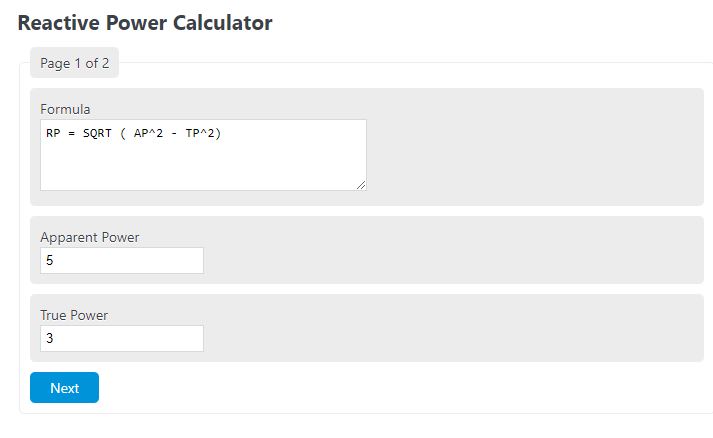
Calculate reactive power from kW and kVA or from voltage, current, and power factor. Size kVAR correction and compare phase angle and line current.
- All Physics Calculators
- All Electrical Calculators
- Apparent Power Calculator
- Phase Difference Calculator
- Power Dissipation Calculator
- 3 Phase Current Calculator
- True Power Calculator
Reactive Power Formula
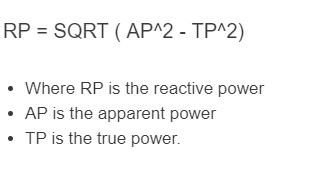
The following formula is used to calculate a reactive power value.
- Where Q is the reactive power (magnitude), typically measured in VAR
- S is the apparent power, typically measured in VA
- P is the true (real) power, typically measured in W
To calculate reactive power (magnitude), subtract the true power squared from the apparent power squared, then take the square root of the result. This relationship assumes sinusoidal steady-state conditions with negligible harmonic distortion (so that S2 = P2 + Q2). Note that reactive power can be positive (inductive) or negative (capacitive); the square-root form gives the magnitude. Use consistent units for S and P before applying the formula.
Reactive Power Definition
Reactive power (Q) is the portion of AC power associated with energy that is alternately stored and returned by inductors and capacitors. It arises when the AC voltage and current are out of phase and is measured in volt-amperes reactive (VAR).
Is reactive power good or bad?
Reactive power is necessary in AC systems (motors, transformers, and power networks) and is commonly used for voltage control. However, excessive reactive power demand or unnecessary reactive power flow increases current, raises I²R losses, and can reduce the usable capacity of conductors and equipment. Good system operation is typically about managing reactive power to keep voltages within limits while minimizing losses.
How does reactive power affect voltage?
In many power systems, injecting reactive power locally (supplying VARs, such as with capacitor banks) tends to raise voltage, while absorbing reactive power (consuming VARs, such as with inductive loads) tends to lower voltage. The exact effect depends on the network impedance, loading, and where the reactive power is produced or consumed.
Does DC have reactive power?
In steady-state DC circuits, there is no reactive power because there is no sinusoidal phase shift between voltage and current. Reactive power is primarily an AC concept associated with alternating energy storage in inductors and capacitors.
Can reactive power be 0?
Reactive power can be zero when the phase angle between the voltage and current is 0° (they are in phase). In these cases, the system has unity power factor (power factor = 1). In these types of electrical systems, only real power is consumed by the circuit.
Reactive Power Example
How to calculate reactive power?
- First, determine the apparent power.
Calculate the apparent power.
- Next, determine the true power.
Calculate the true power.
- Finally, calculate the reactive power.
Calculate the reactive power using the equation above.
FAQ
Reactive power (Q) is the portion of apparent power that does no net work over a cycle and is associated with energy storage in inductors and capacitors. Under sinusoidal conditions, Q = V × I × sin(φ) (single-phase), is measured in VAR, and indicates how much the voltage and current are out of phase.