Select resistance, current magnitude, or dissipated power and enter the two known values using ohms, amps, watts, and kΩ/mA/kW unit conversions with steps.
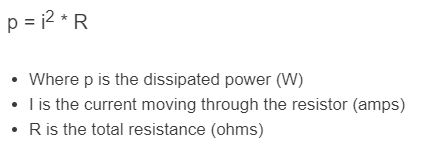
Power Dissipation Formula
Select the quantity to solve and enter the two known quantities: resistance, current magnitude, and dissipated power. Zero resistance or zero current can make an inverse indeterminate or incompatible. In a resistive component, power dissipation is the rate at which electrical energy is converted into heat. That makes this calculation useful for resistor sizing, thermal checks, circuit troubleshooting, and verifying that a component is operating within its safe wattage range.
If you need to solve for a different variable, the same relationship can be rearranged as follows.
Variable Guide
| Quantity | Common Units | What It Represents |
|---|---|---|
| Power dissipation | W, kW | The amount of heat released by the resistor each second. |
| Current | A, mA | The electrical current flowing through the resistive element. |
| Resistance | Ω, kΩ | The opposition the component provides to current flow. |
How to Calculate Power Dissipation
- Determine the resistance of the resistor or equivalent resistance of the resistive path.
- Measure or identify the current flowing through that resistance.
- Square the current value.
- Multiply the squared current by the resistance to obtain dissipated power in watts.
If your current is entered in milliamps or your resistance is entered in kilo-ohms, make sure the units are interpreted correctly before comparing the result to a component’s wattage rating. Unit mix-ups are one of the most common reasons for answers that appear far too large or far too small.
Equivalent Power Equations
For purely resistive loads, power can also be written using voltage. These forms are useful when the circuit voltage is easier to measure than the current, or when you want to cross-check a result.
All of these equations describe the same physical idea: electrical energy is being transformed, usually into heat, inside the component. The best equation is simply the one that matches the values you already know.
Quick Example
If a resistor has a resistance of 10 Ω and carries 2 A of current, the dissipated power is:
That means the resistor is converting 40 joules of electrical energy into heat every second. In practical design, a resistor should not usually be selected with a rating exactly equal to the calculated dissipation for continuous operation. Leaving thermal margin helps reduce temperature rise and improves reliability.
Why Power Dissipation Matters
- Component protection: A resistor that dissipates more power than its rating can overheat, drift in value, discolor, or fail.
- Thermal design: Heat affects nearby components, enclosure temperature, PCB life, and long-term circuit stability.
- Energy awareness: Dissipated power represents energy that is not being delivered as useful output in many circuits.
- Safety: High-power resistors, braking resistors, and current-limiting parts can reach dangerous surface temperatures.
Practical Design Notes
- Use RMS values for AC: In alternating-current resistive circuits, average heating is based on RMS current or RMS voltage, not peak values.
- Check resistor wattage: The calculated dissipation should stay below the resistor’s power rating during normal operation.
- Consider ambient temperature: A resistor in a hot enclosure can run much hotter than the same resistor in open air.
- Watch pulse loading: Short bursts of power may be acceptable in some parts even when continuous dissipation at that level is not.
- Account for equivalent resistance: In networks with series or parallel resistors, use the correct effective resistance for the branch being analyzed.
Common Mistakes
- Entering milliamps as amps.
- Using kilo-ohms when the circuit value is actually in ohms.
- Comparing calculated watts to the wrong component’s rating.
- Using peak AC values instead of RMS values.
- Assuming all electrical power in a circuit is dissipated in a single resistor.
FAQ
Does more current always increase power dissipation?
Yes. In the resistor-based form of the equation, current is squared, so increases in current have a strong effect on heat generation. If current doubles while resistance stays the same, dissipated power becomes four times larger.
Does a higher resistance always mean more dissipated power?
Not always. It depends on what remains fixed in the circuit. If current is fixed, higher resistance causes higher dissipation.
If voltage is fixed, higher resistance causes lower dissipation.
Is dissipated power the same as heat?
For resistors and other mostly resistive elements, dissipated power is effectively released as heat. That is why power dissipation calculations are directly tied to temperature rise and wattage ratings.
Can this be used for more than a single resistor?
Yes, as long as you use the correct current through the element and the correct resistance of the path you are evaluating. In larger circuits, this often means finding branch current or equivalent resistance first.