Calculate DC and AC true power, power factor, reactive and apparent power, impedance, or average power from energy and time in watts.
- All Physics Calculators
- All Electrical Calculators
- Apparent Power Calculator
- Reactive Power Calculator
- Active Power Calculator
True Power Formula
True power is the actual rate at which electrical energy is converted into heat, motion, light, or other useful output in a load. For a purely resistive circuit, true power can be calculated directly from the applied voltage and the load resistance.
| Variable | Meaning | Common Unit |
|---|---|---|
| Pt | True power delivered to the load | watts (W) |
| E | Voltage across the load | volts (V) |
| R | Electrical resistance of the load | ohms (Ω) |
If you need to solve for a different variable, the same relationship can be rearranged as follows:
How to Calculate True Power
- Determine the voltage across the load.
- Determine the resistance of the load.
- Square the voltage value.
- Divide that result by the resistance.
- The final value is the true power in watts.
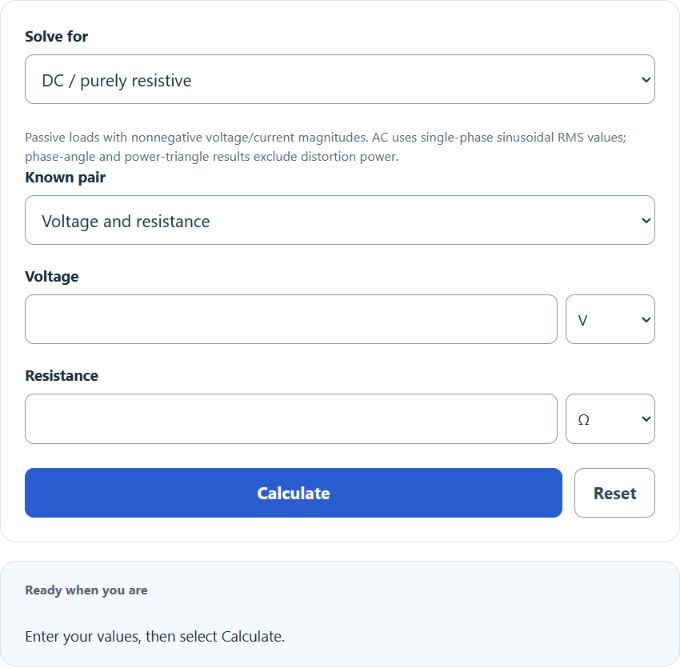
Select a DC/resistive known pair, an AC known-quantity set, or an energy solve. Enter the displayed known values; the result shows true or average power and supported secondary values. Other AC combinations can be entered with unknown fields blank, and redundant values are checked for consistency.
Examples
Example 1
If the voltage across a load is 43 V and the resistance is 85 Ω, then the true power is:
The load is dissipating approximately 21.75 W of true power.
Example 2
If the voltage is 58 V and the resistance is 60 Ω, then:
The true power is 56.07 W.
When to Use This Calculator
- Estimating the power dissipated by a resistor
- Checking heating-element or load wattage
- Analyzing simple DC circuits
- Evaluating resistive AC loads using RMS voltage
- Solving for missing voltage or resistance when power is known
AC Circuit Note
The voltage-and-resistance method assumes a purely resistive load. The AC solver uses a passive single-phase sinusoidal RMS model, where power factor equals the cosine of phase angle. Its phase-angle and power-triangle calculations do not cover waveform distortion or three-phase totals.
For that reason, use RMS voltage for AC inputs, and use caution when applying the resistance-based formula to non-resistive loads.
Common Mistakes
- Entering current instead of voltage
- Using peak AC voltage instead of RMS voltage
- Mixing volts, kilovolts, ohms, and kiloohms without converting units when calculating manually
- Applying the formula to loads with significant reactance or poor power factor
- Forgetting that very small resistance values can produce very large power results
Unit Tips
The calculator supports multiple unit scales for convenience. If you solve manually, convert values to standard units first so the output power is consistent. In practice, that usually means volts for voltage, ohms for resistance, and watts for power.