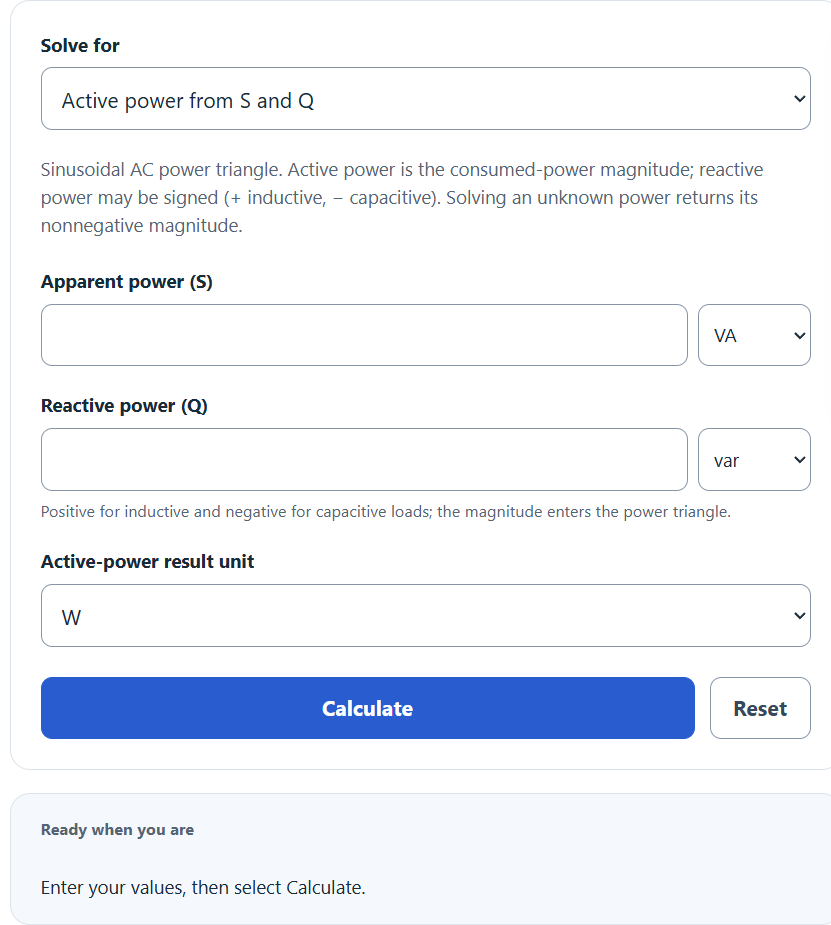
Calculate active, reactive or apparent power from any two values, and find power factor from active and apparent power in W, VA, kW, kVA and MW.
- All Physics Calculators
- All Electrical Calculators
- Reactive Power Calculator
- True Power Calculator
- Apparent Power Calculator
Active Power Formula
For sinusoidal AC, select Active power from S and Q and use the following power-triangle formula. Unknown active and reactive powers are nonnegative magnitudes; signed reactive inputs are accepted. Power-factor modes use PF = P/S and do not infer reactive power under harmonic distortion.
- Where Pa is the Active Power (watts)
- AP is the apparent power (VA)
- RP is the reactive power (var)
How to Calculate Active Power?
The following two example problems outline how to calculate the Active Power.
Example Problem #1:
- First, determine the apparent power (VA). In this example, the apparent power (VA) is measured to be 40.
- Next, determine the reactive power (var). For this problem, the reactive power (var) is calculated to be 20.
- Finally, calculate the Active Power using the formula above:
Pa = SQRT ( AP^2 – RP^2)
Inserting the values from above and solving the equation with the imputed values gives:
Pa = SQRT (40^2 – 20^2) = 34.64 (watts)
Example Problem #2:
Using the same process as example problem 1, we first define the variables outlined by the formula. In this case, the values are:
apparent power (VA) = 70
reactive power (var) = 20
Entering these values into the formula or calculator above gives us: Pa = SQRT ( 70^2 – 20^2) = 67.08 (watts)