Calculate mirror equation values by finding object distance, image distance, focal length, or radius of curvature from two independent inputs or convert between focal length and radius.
- All Physics Calculators
- Magnification Calculator
- Image Distance Calculator
- Field of View Calculator
- Angle of View Calculator
- Minimum Focus Distance Calculator
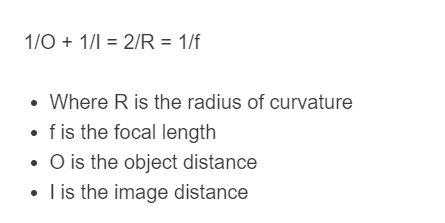
Mirror Equation Formula
The mirror equation relates object distance, image distance, focal length, and radius of curvature for a spherical mirror. Two independent known values determine the other values; focal length and radius alone do not determine object and image distances.
Useful rearrangements for solving the missing value are shown below.
In these equations:
- O = object distance from the mirror
- I = image distance from the mirror
- f = focal length
- R = radius of curvature
For spherical mirrors in the paraxial approximation, the center of curvature is twice as far from the mirror as the focal point, which is why radius and focal length are tied together so closely.
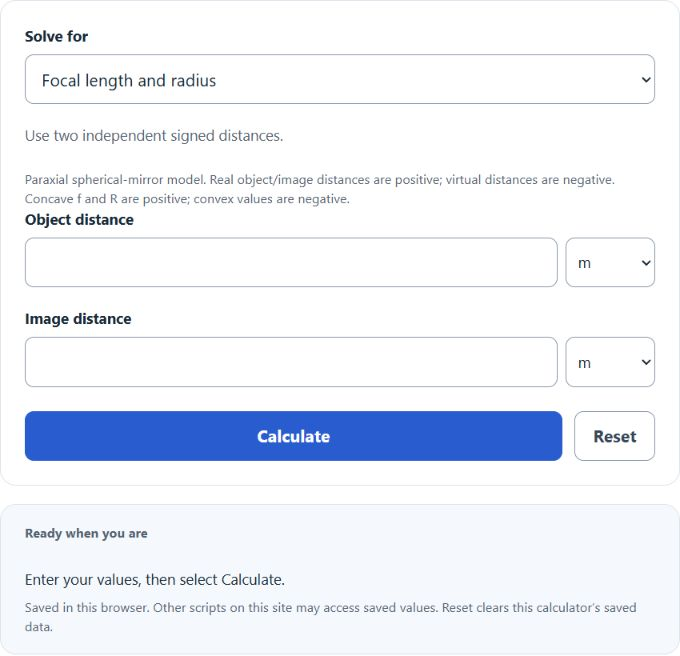
How to Use the Calculator
- Select the value to solve for, then enter the displayed known quantities. Focal length and radius are dependent (R = 2f).
- Choose the unit for each entry; the calculator converts all distances to metres.
- Apply a consistent sign convention if your problem includes real and virtual images.
- Interpret the result physically: shorter focal length means a more strongly curved mirror, while a larger radius means a flatter mirror.
Mirror Sign Convention
The equation is most useful when distances are entered with the standard optics sign convention.
- Real object: object distance is typically positive.
- Real image: image distance is positive when the image forms in front of the mirror.
- Virtual image: image distance is negative when the image appears behind the mirror.
- Concave mirror: focal length and radius of curvature are positive.
- Convex mirror: focal length and radius of curvature are negative.
Distances are measured along the principal axis from the mirror surface. If signs are mixed incorrectly, the calculator can still produce a number, but the physical interpretation may be wrong.
What the Results Mean
- Positive focal length usually indicates a concave mirror.
- Negative focal length usually indicates a convex mirror.
- Larger absolute radius of curvature means the mirror surface is less curved.
- Smaller absolute focal length means the mirror bends light more strongly.
If you also need image size, magnification can be found from the image and object distances.
A negative magnification corresponds to an inverted image, while a positive magnification corresponds to an upright image.
Examples
Concave mirror producing a real image: if the object is 30 cm from the mirror and the image forms 60 cm in front of the mirror, the focal length and radius are:
Convex mirror producing a virtual image: if the object is 30 cm in front of the mirror and the image appears 15 cm behind the mirror, then the image distance is negative and:
The negative values indicate a convex mirror, which always has a virtual focal point behind the mirror.
Common Cases to Remember
- Object beyond the center of curvature of a concave mirror: image is real, inverted, and reduced.
- Object at the center of curvature: image is real, inverted, and the same size.
- Object between the center of curvature and focal point: image is real, inverted, and magnified.
- Object inside the focal length of a concave mirror: image is virtual, upright, and magnified.
- Object in front of a convex mirror: image is always virtual, upright, and reduced.
Common Mistakes
- Using the wrong unit selection for a distance; mixed units are supported when selected correctly.
- Forgetting that virtual images use a negative image distance in the standard sign convention.
- Confusing radius of curvature with the physical width or diameter of the mirror.
- Using the equation for a plane mirror, which does not have a finite focal length or radius of curvature.
FAQ
Why is the radius of curvature twice the focal length?
For a spherical mirror in the paraxial approximation, the focal point lies halfway between the mirror surface and the center of curvature.
What happens when the object is placed at the focal point?
The reflected rays leave parallel to one another, so the image forms extremely far away.
Does this equation work for any curved mirror?
It is intended for spherical mirrors and is most accurate for rays close to the principal axis. Large-angle rays can introduce spherical aberration, so real optical systems may deviate slightly from the ideal result.
Why can focal length be negative?
A negative focal length means the mirror is diverging light rather than converging it. That is the normal behavior of a convex mirror.