Calculate horizontal, vertical, and diagonal angle of view, required focal length, or scene coverage from sensor format, lens focal length, and distance.
- All Physics Calculators
- Field of View Calculator
- Magnification Calculator
- Vertical FOV Calculator
- Distance Angle Calculator
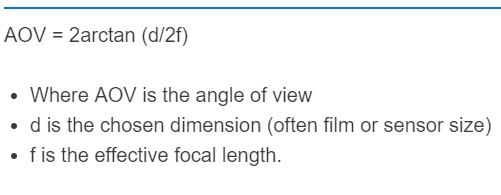
Angle of View Formula
The calculator uses one core trigonometric relationship and rearranges it for each mode.
Frame size mode:
Focal length mode:
- AOV = angle of view in degrees (horizontal, vertical, or diagonal)
- d = sensor dimension (width, height, or diagonal) in mm
- f = lens focal length in mm
- D = subject distance in mm
- Frame = the width, height, or diagonal of the scene captured at distance D
Assumptions: the formula treats the lens as a thin lens focused at infinity, ignores distortion, and assumes the subject distance is much larger than the focal length. At close-focus distances, image distance and focus breathing can change coverage substantially; the direction and magnitude depend on the lens. This calculator does not model those effects. The 35mm-equivalent focal length shown in results scales by the ratio of the full-frame diagonal (43.27 mm) to your sensor diagonal.
Reference Tables
Diagonal angle of view for common focal lengths on popular sensor formats:
| Focal length | Full-frame | APS-C (23.6 × 15.7 mm) | MFT | 1-inch |
|---|---|---|---|---|
| 14 mm | 114° | 91° | 75° | 59° |
| 24 mm | 84° | 61° | 49° | 37° |
| 35 mm | 63° | 44° | 34° | 26° |
| 50 mm | 47° | 32° | 24° | 18° |
| 85 mm | 29° | 19° | 15° | 11° |
| 200 mm | 12° | 8° | 6° | 5° |
How a diagonal angle translates to lens character on a full-frame body:
| Diagonal AOV | Lens type | Typical use |
|---|---|---|
| Above 90° | Ultra-wide | Interiors, real estate, astro |
| 63° to 84° | Wide | Landscape, environmental |
| 40° to 63° | Normal | Documentary, street, video |
| 18° to 40° | Short telephoto | Portraits, products |
| 8° to 18° | Telephoto | Sports, wildlife |
| Below 8° | Super-telephoto | Distant wildlife, surveillance |
Worked Example
A 50 mm lens on a full-frame sensor (36 × 24 mm, diagonal 43.27 mm):
- Horizontal: 2 × arctan(36 / 100) = 39.6°
- Vertical: 2 × arctan(24 / 100) = 27.0°
- Diagonal: 2 × arctan(43.27 / 100) = 46.8°
At a distance of 3 m from the subject, the frame covers 3 × 36 / 50 = 2.16 m wide by 1.44 m tall. To fit a 2 m wide subject from that same 3 m distance, you need 36 × 3000 / 2000 = 54 mm.
FAQ
Why are three angles reported? Lens specs usually quote the diagonal value because it is the largest, but the horizontal and vertical angles tell you what fits left-to-right and top-to-bottom. Use diagonal for comparing lenses, horizontal or vertical for framing real subjects.
Does the angle change when I focus closer? It can. Focus breathing and the lens design can change angle of view, especially at close focus. Check lens-specific data; this distant-focus model does not predict that change.
How does crop factor relate to this? Crop factor is the ratio of the full-frame diagonal to your sensor diagonal. Multiplying your focal length by the diagonal crop factor gives the full-frame focal length with the same diagonal angle of view; horizontal and vertical framing also match only when aspect ratios match, which is the "35mm equivalent" shown in the results.