Calculate microscope field of view from eyepiece field number, objective magnification, and auxiliary factor, or telescope true field of view.
Field of View Formula
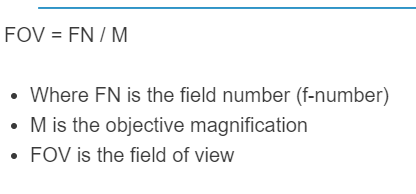
The following formula is used to calculate the linear field of view for a microscope (field diameter at the specimen plane) from the eyepiece field number and the objective magnification.
- Where FN is the eyepiece field number (a length, typically in mm; often printed like “FN 20”)
- M is the objective magnification (e.g., 10 for 10×); A is the auxiliary lens or tube factor (use 1 without an auxiliary factor).
- FOV is the linear field of view at the specimen plane (same length unit as FN)
To calculate microscope field of view, divide the field number (FN) by the objective magnification multiplied by the auxiliary factor. For the telescope mode, magnification is telescope focal length × Barlow/reducer factor ÷ eyepiece focal length, and true field is estimated as apparent eyepiece field ÷ magnification.
Field of View Definition
Field of view (FOV) is the extent of the observable area seen through an optical system. In microscopy it is often expressed as a linear size (e.g., the diameter of the visible circle at the specimen plane). In telescopes and cameras it is often specified as an angular field of view (degrees), which is calculated differently.
Field of View Example
How to calculate a field of view?
- First, determine the field number (FN).
Find the eyepiece field number (often labeled “FN” and given in mm).
- Next, determine the objective magnification.
Use the objective magnification (e.g., 10×, 40×).
- Finally, calculate the field of view.
Calculate the field of view using the equation above.
FAQ
Field of view (FOV) is the extent of the observable area. For microscopes it is commonly the linear diameter/width of the visible area at the specimen plane; for many other optical systems it may be given as an angular field of view (degrees).