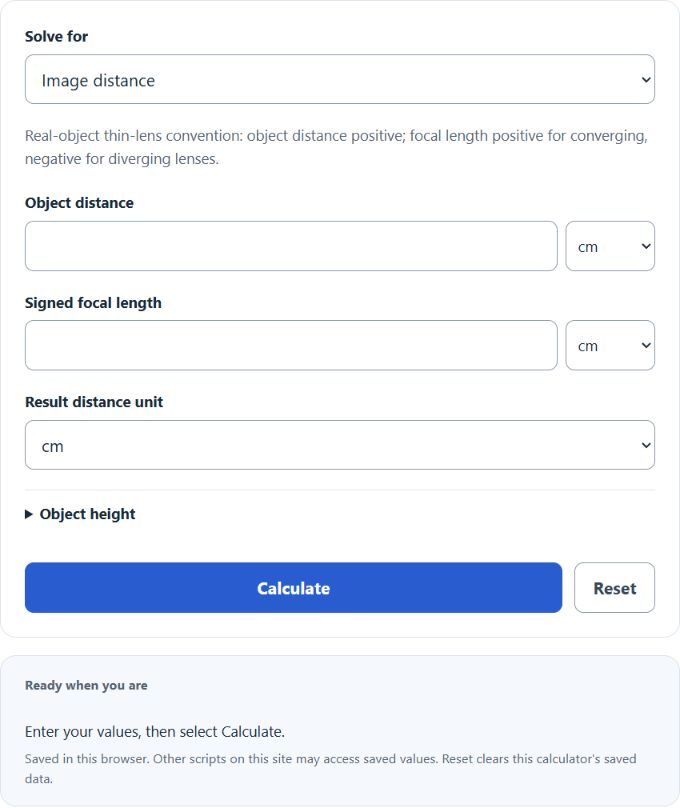
Calculate thin-lens image distance, object distance, or focal length with unit conversion, magnification, image orientation, scale, height, and lens power.
Image Distance Formula
Image distance is the distance from a lens or mirror to the location where the image forms. In introductory optics, the relationship between object distance, focal length, and image distance is modeled with the thin-lens or mirror equation below.
If you want to solve directly for image distance, the equation can be rearranged to:
For hand calculations use consistent units. This calculator converts each selected input unit to meters internally and offers a separate result unit. Changing an input unit preserves its physical quantity.
Variable Definitions
| Variable | Meaning | Practical Use |
|---|---|---|
| Di | Image distance | Shows where the image forms relative to the optical element. |
| F | Focal length | Describes how strongly the lens or mirror bends light. |
| O | Object distance | Measures how far the object is from the lens or mirror. |
Rearranged Forms
Because the calculator can solve for any missing value when the other two are known, these alternate forms are often useful:
How to Calculate Image Distance
- Measure the object distance and focal length.
- Convert both values into the same unit if needed.
- Take the reciprocal of the focal length.
- Take the reciprocal of the object distance.
- Subtract the object-distance reciprocal from the focal-length reciprocal.
- Take the reciprocal of that result to get the image distance.
A positive image distance identifies the real-image plane on the outgoing-light side of a lens. A negative distance identifies a virtual image on the object side, which cannot be projected directly onto a screen.
Example
If the object distance is 12 cm and the focal length is 4 cm, substitute those values into the formula:
The image forms6cm from the lens, with magnification−0.5: real, inverted and reduced. For a2cm object, signed image height is−1cm and its magnitude is1cm.
How to Interpret the Result
- Positive image distance: In the common lens sign convention, this usually indicates a real image that can be projected onto a screen.
- Negative image distance: This usually indicates a virtual image, meaning the image appears to come from a point on the same side as the object.
- Large image distance: The object is close to the focal position, so the image plane moves farther away.
- Image distance close to focal length: This often happens when the object is very far from the lens or mirror.
Important Special Cases
- Object distance equal to focal length: No finite image distance exists; the image forms at infinity.
- Object farther than the focal length: A converging lens typically forms a real image.
- Object closer than the focal length: A converging lens typically forms a virtual, upright image.
- Very distant object: The image location approaches the focal point.
Common Mistakes
- Mixing units, such as entering object distance in centimeters and focal length in inches.
- Forgetting that the equation uses reciprocals, not direct subtraction of distances.
- Measuring from the wrong reference point instead of the lens or mirror.
- Expecting a normal finite answer when the object is positioned exactly at the focal length.
- Ignoring sign conventions in more advanced optics problems.
Useful Related Relationship
Once image distance is known, image size can also be estimated with the magnification relationship:
This is helpful when you want to know not only where the image forms, but also whether it appears enlarged, reduced, upright, or inverted.
When This Calculator Is Most Useful
This calculator supports real-object, paraxial thin-lens problems. It reports signed image distance, magnification, height and lens power; virtual objects, thick-lens effects and aberrations are outside its model. The same reciprocal equation is often used for spherical mirrors with the appropriate mirror convention. See OpenStax thin lenses.