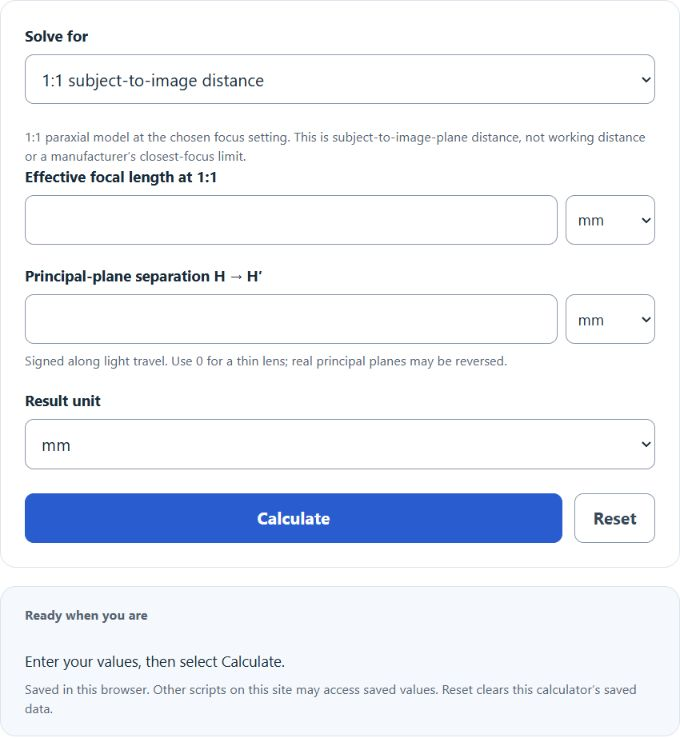
Calculate minimum focus distance, focal length, or signed principal-plane separation for 1:1 macro photography using MFD ≈ 4 × FL + DN.
Related Calculators
- Diffraction Limit Calculator
- Dynamic Range Calculator
- Field of View Calculator
- Angle of View Calculator
- Focal Length to Zoom Calculator
- Lens Thickness Calculator
- All Physics Calculators
Minimum Focus Distance (1:1 Estimate) Formula
This calculator estimates the subject-to-image-plane distance for a lens focused to 1:1 magnification. In practical terms, it gives a quick close-focus estimate for macro-style imaging by combining focal length with the separation between the lens’s principal planes at the 1:1 focus setting.
In this equation:
- MFD = subject-to-image-plane distance at 1:1; not a mechanical closest-focus limit
- FL = focal length
- DN = signed separation from the front to rear principal plane along light travel
Select units for each input and the result; the calculator converts internally. DN is signed along light travel and can be negative when the principal planes are reversed. Use zero for a thin-lens model.
Variable Definitions
| Term | Meaning | Why It Matters |
|---|---|---|
| Focal Length (FL) | The lens focal length used in the optical model | In this estimate, longer focal lengths produce larger minimum focus distances. |
| Signed Principal-Plane Separation (DN) | The separation between the principal planes used to approximate the lens geometry | This adds a fixed amount to the total subject-to-image-plane distance. |
| Minimum Focus Distance (MFD) | The estimated distance from the subject to the image plane at life-size reproduction | Useful for macro planning, optical comparison, and checking close-focus feasibility. |
Rearranged Forms
If you need to solve for a different variable, use one of these forms:
Why the Estimate Uses Four Times the Focal Length
At 1:1 magnification, a simplified lens model places both the object distance and the image distance at about twice the focal length when measured from the principal planes. Adding those distances together and then accounting for principal-plane separation leads to the estimate used here.
This is why the calculator is best treated as a 1:1 close-focus estimate, not an exact specification for every real-world lens design.
How to Calculate Minimum Focus Distance
- Select input and result units; use focal length and principal-plane locations at the 1:1 focus setting.
- Multiply the focal length by four.
- Add the signed principal-plane separation.
- Interpret the result as a subject-to-image-plane distance.
That process can be summarized as:
Example 1
A lens has a focal length of 100 mm and a positive principal-plane separation of 20 mm.
The estimated minimum focus distance is 420 mm, which is 42 cm.
Example 2
If the estimated minimum focus distance is 300 mm and the positive principal-plane separation is 20 mm, the focal length can be found by rearranging the equation.
The implied focal length is 70 mm.
Quick Reference Values
| Focal Length | DN | Estimated MFD |
|---|---|---|
| 50 mm | 15 mm | 215 mm |
| 85 mm | 20 mm | 360 mm |
| 100 mm | 20 mm | 420 mm |
| 150 mm | 25 mm | 625 mm |
How to Interpret the Result
The output represents the distance from the subject to the image plane. On a digital camera, the image plane is the sensor plane. This is not the same as the visible gap from the front of the lens to the subject.
- Minimum focus distance is usually measured to the sensor or image plane reference.
- Working distance is the smaller front-of-lens clearance available for lighting and subject access.
- A lens can have a useful minimum focus distance but still leave very little working space.
Why Real Lens Specs May Differ
This calculator uses a clean optical approximation. Actual manufacturer values can differ because real lenses are not perfect thin lenses and often change behavior at close focus.
- Internal focusing can change effective focal length at short distances.
- Complex lens groups shift the principal planes as focus changes.
- Focus breathing can alter framing and close-focus geometry.
- Specification method may differ from the assumptions in the 1:1 estimate.
- Accessories such as extension tubes or bellows change close-focus performance.
Minimum Focus Distance vs. Working Distance
These terms are often confused, but they are not interchangeable:
- Minimum focus distance tells you how close the subject can be to the image plane.
- Working distance tells you how much physical room remains between the front of the lens and the subject.
For macro photography, working distance is often the more practical number when lighting insects, flowers, small products, or scientific samples.
Practical Tips
- Select the correct unit for each input before calculating.
- Use this estimate for planning and comparison, not as a substitute for a lens manufacturer’s exact measured specification.
- If you need more room for lighting or for skittish subjects, a longer focal length often provides a larger estimated minimum focus distance.
- When comparing close-up lenses, consider magnification, working distance, and minimum focus distance together.
Frequently Asked Questions
Is a smaller minimum focus distance always better?
Not always. A smaller value means the system can focus closer, but the best choice depends on subject size, desired magnification, and how much physical clearance you need.
Can this calculator be used for macro lens planning?
Yes. It is especially useful for estimating close-focus behavior at life-size reproduction and for understanding how focal length affects the total subject-to-image-plane distance.
Will this match every camera and lens exactly?
No. It is an approximation based on a simplified 1:1 model. Real lenses may produce different values because of their internal optical design and focusing method.