Calculate dynamic range from signal and noise levels, bit depth, luminance, voltages, pressure, or sensor data, plus ratio and dB conversions. Bit-depth and ENOB modes report ideal quantization SNR and equivalent SINAD respectively, rather than measured dynamic range.
Related Calculators
- Sampling Frequency Calculator
- Oscilloscope Voltage Calculator
- Common Emitter Amplifier Calculator
- Transistor Base Current Calculator
- All Physics Calculators
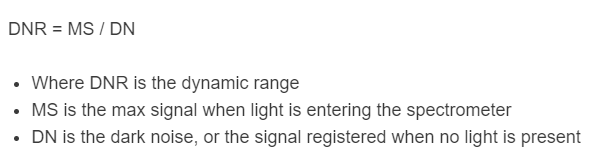
Dynamic Range Formula
The following formula is used to calculate a dynamic range.
- Where DR is the dynamic range
- MS is the maximum usable (non-saturating) signal
- DN is the noise floor (commonly the RMS noise / standard deviation of repeated dark measurements; in practice it may include dark noise, read noise, etc.)
To calculate dynamic range as a ratio, divide the max signal by the noise floor. If you need dynamic range in decibels, convert the ratio using 20·log10 for amplitude quantities (e.g., volts, pressure, electron counts) or 10·log10 for power-like quantities (e.g., optical power, luminance).
Dynamic Range Definition
Dynamic range is the ratio between the largest measurable signal (before saturation or clipping) and the smallest signal that can be reliably distinguished from the noise floor. For a spectrometer, this is commonly expressed as the maximum non-saturating signal divided by the RMS noise (often estimated from repeated dark measurements).
Dynamic Range Example
How to calculate dynamic range?
- First, determine the maximum signal.
Measure or calculate the maximum non-saturating signal (the largest signal before clipping/saturation).
- Next, determine the noise floor (dark noise).
Estimate the noise floor by taking repeated dark measurements (no light) under a defined measurement procedure and computing the noise standard deviation at each wavelength/pixel.
- Finally, calculate the dynamic range.
Calculate the dynamic range using the formula above (ratio or dB, depending on how you want to report it).
FAQ
A spectrometer is an instrument that measures the intensity of electromagnetic radiation as a function of wavelength (or frequency). The resulting spectrum can be used to help identify materials and their composition.