Calculate an acute impact angle from elliptical width and length, reverse-solve expected width, and inspect unit-normalized ratios and uncertainty bounds.
Angle of Impact Formula
The angle of impact is found from the relationship between the width of a blood droplet and the length of the stain or splatter mark. The calculator uses the sine relationship:
- theta = angle of impact
- W = width of the droplet or stain
- L = length of the splatter or stain
If you are solving for the width instead of the angle, the calculator rearranges the formula:
- W = width of the droplet or stain
- theta = angle of impact
- L = length of the splatter or stain
If you are solving for the length, the calculator uses:
- L = length of the splatter or stain
- W = width of the droplet or stain
- theta = angle of impact
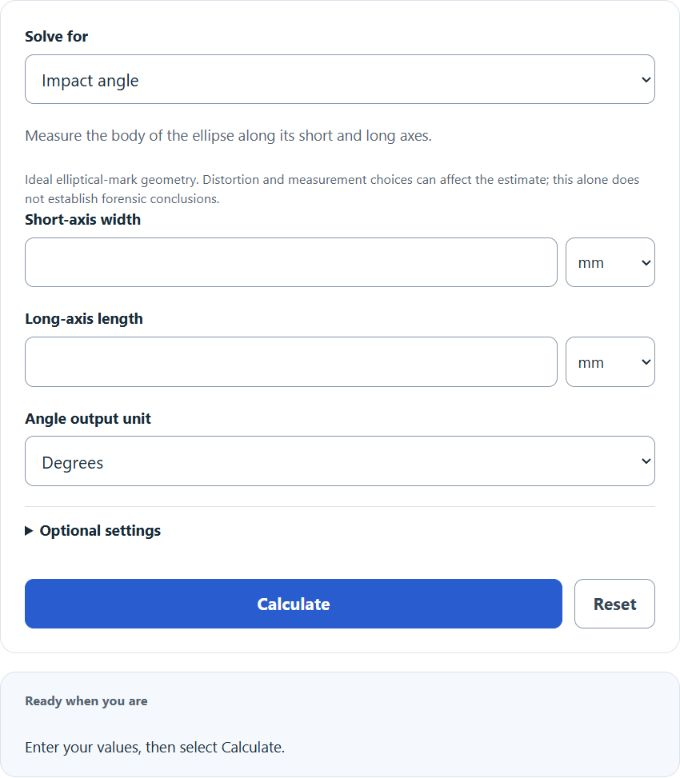
Select angle, expected width, or expected length, then enter the two shown required values. In angle mode, an optional shared absolute uncertainty gives conservative measurement bounds, not a confidence interval. Width and length can be entered in different units, such as millimeters, centimeters, meters, inches, or feet. The calculator converts the length measurements to a common unit before applying the formula. The angle can be entered or returned in degrees or radians.
Angle and Width-to-Length Ratio Reference
The angle of impact depends on the ratio of width to length. A rounder stain has a higher angle. A longer, narrower stain has a lower angle.
| Width ÷ Length | Approximate Angle of Impact | Stain Shape |
|---|---|---|
| 0.17 | 10° | Very elongated |
| 0.34 | 20° | Long and narrow |
| 0.50 | 30° | Moderately elongated |
| 0.71 | 45° | Oval |
| 0.87 | 60° | Nearly round |
| 1.00 | 90° | Round |
Unit Conversion Values Used
| Unit | Equivalent in Millimeters |
|---|---|
| 1 mm | 1 mm |
| 1 cm | 10 mm |
| 1 m | 1000 mm |
| 1 in | 25.4 mm |
| 1 ft | 304.8 mm |
Examples
Example 1: Calculate angle of impact
You measure a stain with a width of 6 mm and a length of 12 mm.
The angle of impact is 30°.
Example 2: Calculate stain length
You know the width is 8 mm and the angle of impact is 45°.
The length of the splatter is about 11.31 mm.
FAQ
Why can’t the width be greater than the length?
The formula uses width divided by length inside the arcsine function. That ratio must be between 0 and 1. If the width is greater than the length, the ratio is greater than 1, so the angle calculation is not valid. In practice, check that you measured the longest direction as the length and the shorter direction as the width.
Should the angle of impact be in degrees or radians?
You can use either degrees or radians. The calculator uses radians for trigonometric operations and can display the estimated angle in degrees or radians. For most classroom and forensic bloodstain pattern calculations, degrees are the more common format.
What does a smaller angle of impact mean?
A smaller angle means the droplet struck the surface at a shallower angle, creating a longer and more elliptical stain. A 90° impact is perpendicular to the surface and usually produces a nearly round stain. A low angle, such as 10° or 20°, produces a much longer stain.