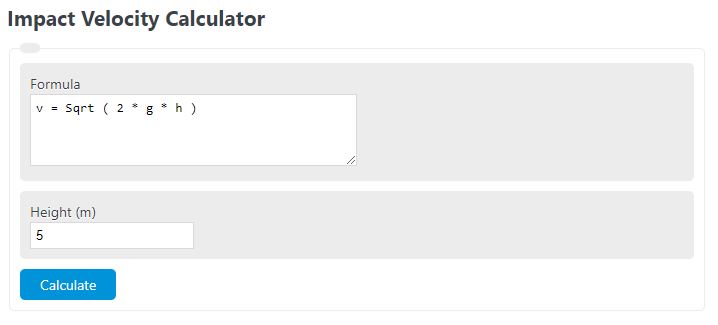
Calculate impact velocity from drop height or solve for height from speed, with selectable units, gravity, fall time, and optional initial velocity.
- All Physics Calculators
- Final Velocity Calculator
- Initial Velocity Calculator
- Maximum Height of a Projectile Calculator
- Angle of Impact Calculator
- Impact G Force Calculator
- Average Impact Force Calculator
- Force From Height Calculator
How the Impact Velocity Calculator Works
The impact velocity calculator estimates the speed of an object just before it strikes the ground or another surface after a vertical drop. It is based on the physics of free fall and is most accurate when the object is released from rest, gravity is treated as constant, and air resistance is small enough to ignore.
This tool can be used in either direction:
- Find impact velocity from a known drop height
- Find drop height from a known impact velocity
Core Free-Fall Formula
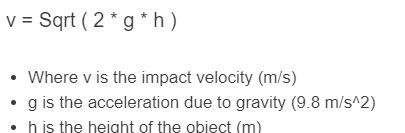
Where:
- v = impact velocity
- g = gravitational acceleration
- h = vertical drop height
If you already know the impact velocity and want to solve for the drop height, rearrange the equation:
For metric calculations, gravity is typically taken as 9.81 meters per second squared. For imperial calculations, gravity is commonly taken as 32.174 feet per second squared:
How to Use the Calculator
- Enter the value you know: either the drop height or the impact velocity.
- Select the appropriate unit system, such as meters, feet, miles per hour, or feet per second.
- Leave the other field blank.
- Run the calculation to solve for the missing value.
Make sure the height represents the vertical distance fallen, not the length of a slope or ramp.
What the Result Means
The output is the object's speed immediately before contact. It does not tell you how hard the collision will be by itself. Impact force depends on more than speed, including the object's mass, the surface it hits, and how far it travels while stopping.
A related average-force estimate is:
In that relationship, m is mass and d is the stopping distance during impact. This is why the same impact velocity can produce very different forces on different surfaces.
Main Assumptions Behind the Calculation
- The object starts from rest.
- The motion is a vertical drop.
- Gravity stays constant throughout the fall.
- Air resistance is ignored.
- No bounce, lift, thrust, or propulsion affects the motion.
These assumptions are reasonable for many classroom, engineering, and estimation problems. In real-world conditions, drag can lower the actual impact speed, especially for light objects, objects with large surface area, or very long falls.
Common Drop Heights and Approximate Impact Velocities
| Drop Height | Impact Velocity | Feet per Second | Miles per Hour |
|---|---|---|---|
| 1 m | 4.43 m/s | 14.53 ft/s | 9.91 mph |
| 5 m | 9.90 m/s | 32.50 ft/s | 22.16 mph |
| 10 m | 14.01 m/s | 45.96 ft/s | 31.33 mph |
| 20 m | 19.81 m/s | 64.99 ft/s | 44.31 mph |
| 50 m | 31.32 m/s | 102.76 ft/s | 70.06 mph |
| 100 m | 44.29 m/s | 145.32 ft/s | 99.08 mph |
Example Calculation
If an object is dropped from a height of 10 meters, substitute the height into the free-fall equation:
So the object reaches an impact velocity of about 14.01 meters per second, which is approximately 45.96 feet per second or 31.33 miles per hour.
If the impact velocity is known instead, such as 20 meters per second, you can solve for the drop height:
That means a no-drag fall of about 20.39 meters would produce an impact velocity of about 20 meters per second.
How Height Changes Speed
Impact velocity does not increase linearly with height. It follows a square-root relationship, which means the velocity increases more slowly than the drop distance.
- If the height is multiplied by 2, the velocity is multiplied by about 1.414.
- If the height is multiplied by 4, the velocity doubles.
- If the height is multiplied by 9, the velocity triples.
This is useful when comparing falls from different elevations. A much larger drop does increase the final speed, but not in direct proportion to the added height.
When the Simple Formula Does Not Apply
If the object is already moving when released, the free-fall equation above is no longer the full picture. In that case, the more general kinematics relationship is:
Here, v0 is the initial speed. For a pure drop from rest, the initial speed is zero, which reduces the equation back to the calculator's main formula.
Practical Uses of Impact Velocity
- Estimating landing speed in drop tests
- Comparing fall hazards in safety planning
- Checking physics homework and lab calculations
- Evaluating packaging and product protection scenarios
- Understanding the difference between drop height, speed, and collision force
Frequently Asked Questions
Does mass affect impact velocity?
In ideal free fall, no. If air resistance is ignored, heavy and light objects dropped from the same height reach the same impact velocity.
Why is the real impact speed sometimes lower than the calculator value?
Real falls are influenced by drag, wind, object shape, rotation, and local conditions. These effects reduce acceleration and lower the final speed compared with an ideal no-drag model.
Can this calculator be used with feet and miles per hour?
Yes. Just keep units consistent or let the calculator perform the conversion. A height entered in feet naturally leads to a speed in feet per second before any conversion to other units.
Is impact velocity the same as impact force?
No. Impact velocity measures speed at contact. Impact force depends on speed, mass, stopping distance, material deformation, and how long the object takes to come to rest.
Is impact velocity the same as terminal velocity?
No. Impact velocity is the speed at the moment of contact after a specific fall. Terminal velocity is the maximum steady falling speed reached when drag balances the object's weight.