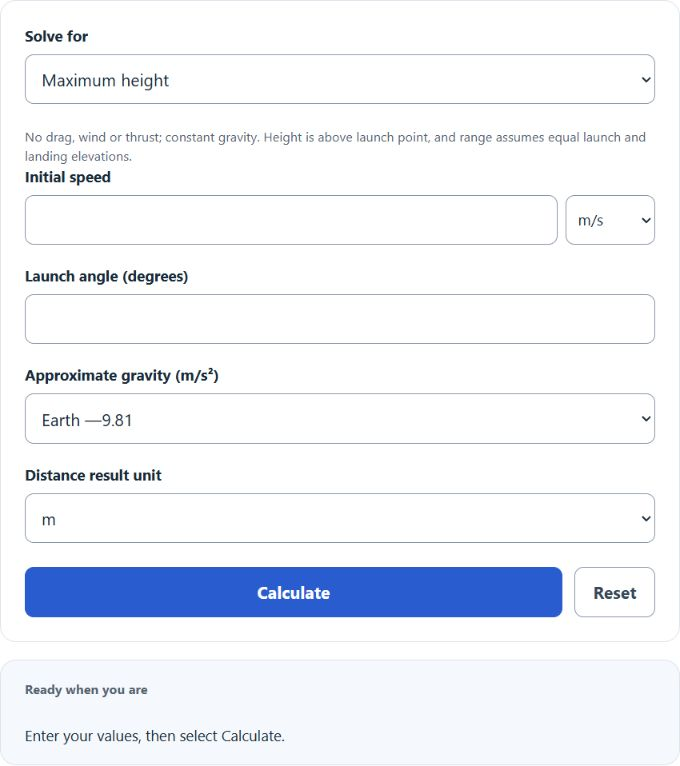
Calculate projectile maximum height, range, or time to apex from initial velocity, launch angle, and gravity on Earth or other planets.
- All Physics Calculators
- Free Fall Calculator
- Relative Velocity Calculator
- Launch Velocity Calculator
Maximum Height and Projectile Formulas
This calculator uses H = v₀²sin²θ/(2g) for height above the launch point, t = v₀sinθ/g for time to apex, and R = v₀²sin(2θ)/g for range when launch and landing elevations match. Select height, initial speed, angle, range or apex time and enter the displayed inputs. The following supplementary relationship uses horizontal displacement X to the apex and gives only the horizontal component Vₓ, not total launch speed.
In this equation, V in the supplementary equations is the horizontal speed component, X is the horizontal displacement from launch to the apex, H is the maximum height above the launch point, and g is gravitational acceleration. For most Earth-based problems, use 9.81 m/s2 (approximately32.185ft/s2).
| Variable | Description | Typical Units |
|---|---|---|
| V | Horizontal speed component in the supplementary relation | m/s, ft/s, km/h, mph |
| X | Horizontal displacement to the apex | m, ft, yd |
| H | Maximum height above the launch point | m, ft, yd |
| g | Acceleration due to gravity | m/s2 or ft/s2 |
Rearranged Forms
For the supplementary relation, V means horizontal speed and X means displacement to the apex. These rearrangements do not replace the calculator’s height/speed/angle inputs:
How to Use the Calculator
- Select the quantity to solve: height, initial speed, angle, range or apex time.
- Enter the displayed known speed, angle or height above the launch point.
- Select the input/result units and approximate gravity.
- Select Calculate. Range requires equal launch and landing elevations.
For the supplementary horizontal-speed relation, H must be positive. The calculator itself accepts zero forward rise and rejects inverse combinations that have no solution or do not determine a unique answer.
Supplementary Horizontal-Speed Example
If displacement from launch to the apex is200m and rise is40m, the horizontal speed component is:
What the Inputs Mean
- Change in x-direction: in the supplementary example, horizontal displacement to the apex; it is not a calculator input.
- Maximum height: the highest vertical position reached above the launch point, not above sea level or some unrelated reference.
- Launch velocity: total initial speed v₀ in the calculator. The supplementary X/H relation instead gives its horizontal component Vₓ.
Assumptions and Limitations
- The calculation assumes ideal projectile motion with no air resistance.
- Gravity is treated as constant for the full motion.
- The maximum height must be measured from the same launch reference used for the horizontal displacement.
- The supplementary X/H relation requires X from launch to the apex, not the full flight range. The calculator’s range formula requires equal launch and landing elevations.
- If your problem includes drag, wind, changing elevation, or additional thrust, a more complete projectile model is required.
Interpretation Tips
- If the horizontal displacement doubles while height stays the same, the horizontal component doubles.
- If the maximum height increases while horizontal displacement stays the same, the horizontal component decreases.
- The result is more sensitive to errors in horizontal distance than equal percentage errors in height.
- Unit conversions matter: a small mistake between feet and meters can significantly change the answer.
Common Questions
Does this calculator include air resistance?
No. It assumes ideal motion, so drag, lift, and wind effects are ignored.
Should maximum height be measured from the ground?
Only if the launch point is at ground level. In general, height should be measured from the actual launch point to the apex.
Can I use imperial units?
Yes. Feet and yards are supported distance units; feet per second and miles per hour are supported speed units. The calculator converts them internally.
Why does a larger height reduce the horizontal component in the supplementary formula?
A larger peak height means the projectile spends more time rising. For the same horizontal displacement, more rise time means less horizontal speed is needed to cover that distance.