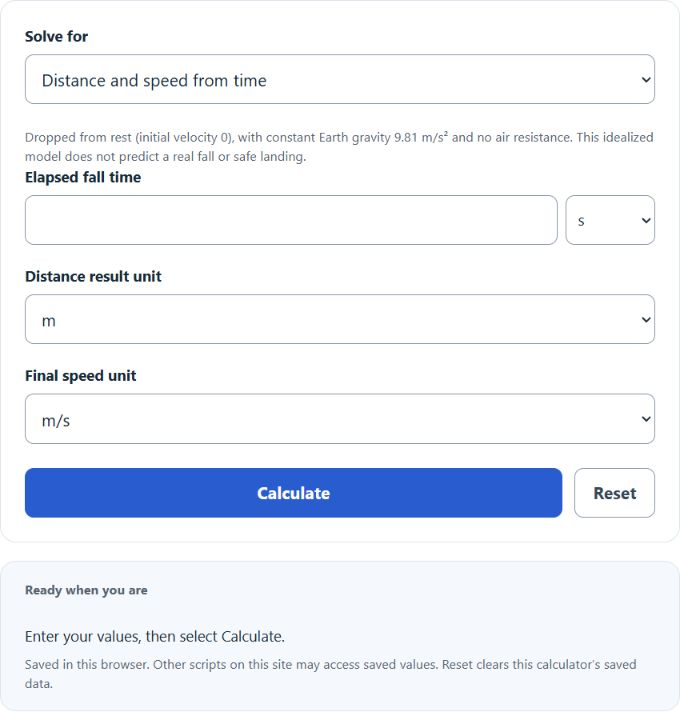
Calculate free fall height or time and final impact speed from the other input, with meters, feet, seconds, and speed unit conversions.
- All Physics Calculators
- Acceleration Calculator
- Velocity Calculator
- Gravitational Force Calculator
- Fall Energy Calculator
Free Fall Formula
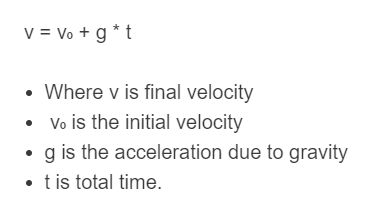
The formula to calculate the final velocity of an object in free fall (taking downward as positive) is:
- Where v is final velocity (m/s)
- v0 is the initial velocity (m/s)
- g is the acceleration due to gravity (m/s²), approximately 9.81 m/s² near Earth’s surface
- t is total time (s)
If the object is dropped from rest (v0 = 0), this simplifies to v = gt. (The direction/sign depends on your chosen coordinate system.)
In many introductory free-fall problems, the distance fallen (height) is known and the time is unknown. If the object is dropped from rest (v0 = 0) and g is treated as constant, the time can be found with:

- where t is total time
- d is distance traveled (height fallen)
- g is the acceleration due to gravity
Free Fall Definition
Free fall is motion under the influence of gravity alone (i.e., with no other forces acting). In reality, air resistance is usually present, but many free-fall problems explicitly neglect it.
How to calculate free fall
Let’s look at an example of how to calculate the kinematic values of an object in free fall.
Consider an idealized object dropped from rest in a vacuum. What are its fall time and final speed? These equations do not predict an actual skydiving fall.
First, we will calculate the fall time. Let’s assume you’re jumping from a height of 10,000 meters and that you start from rest (v0 = 0). Using t = √(2d/g) with g = 9.81 m/s², we get a total time of about 45.15 seconds.
Next, we calculate the final speed (in a vacuum). Using the time from above and v = gt, we get a final speed of about 442.9 m/s.
It should be noted that in a real-world application you would not be going so fast due to air resistance (and you would approach a terminal velocity). The formulas above assume a vacuum and constant g.
The following steps are required to calculate an object in free fall.
- First, determine the vertical distance/height the object falls (displacement).
- Second, determine the initial vertical velocity v0 (often 0 if the object is dropped).
- Last, choose an appropriate value for g (near Earth ≈ 9.81 m/s²) and use the kinematic equations (such as v = v0 + gt and d = v0t + ½gt²) to solve for time and final velocity.
FAQ
Free fall is motion under the influence of gravity alone (neglecting other forces such as air resistance).