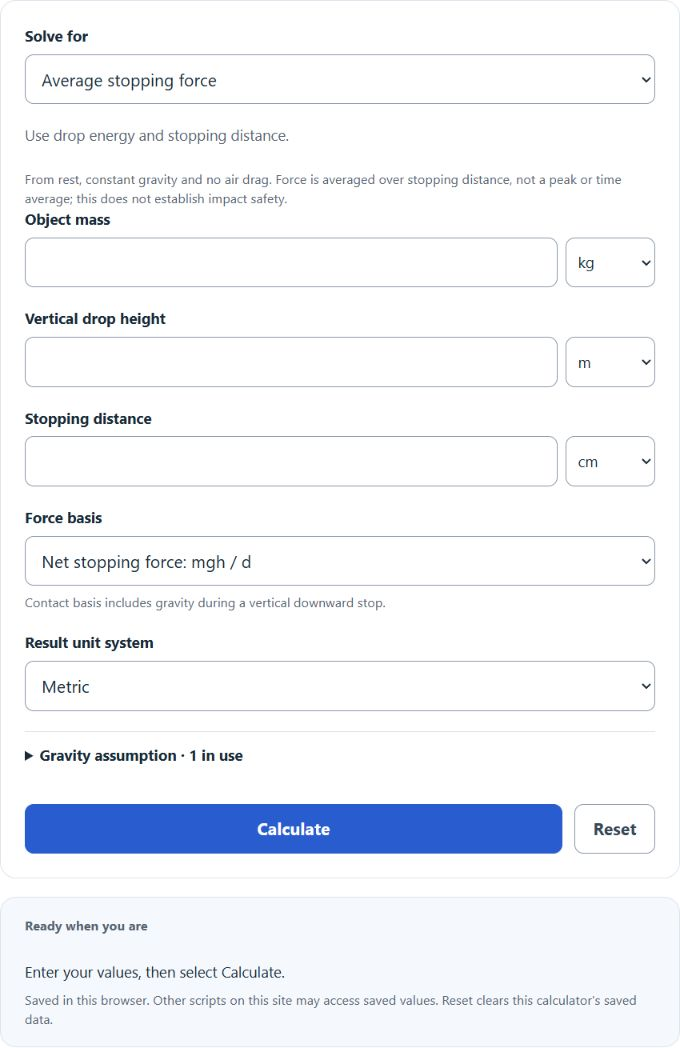
Calculate average impact force, impact speed, fall time, energy, or solve for mass, drop height, and stopping distance in metric and imperial units.
- All Physics Calculators
- All Force Calculators
- Average Impact Force Calculator
- Impact Velocity Calculator
- Angle of Impact Calculator
Force From Height Formula
The following equation gives the average net stopping force from a drop from rest, using the stopping distance. It is not a peak impact force.
- Where F is the average net stopping force (N)
- m is the mass of the object (kg)
- g is the acceleration due to gravity (m/s^2)
- h is the height (m)
- d is the stopping or deformation distance (m)
To calculate force from height, multiply the mass by the height and acceleration due to gravity, then divide by the impact distance.
What is a Force From Height?
Definition:
Drop height alone does not determine impact force. Ignoring air drag, the drop energy is mgh; dividing by stopping distance gives the average net stopping force. During a vertical downward stop, the upward contact force also supports the object’s weight, so its average is mgh/d + mg. The calculator provides both bases and inverse solvers. Neither value determines the peak force or establishes impact safety.
How to Calculate Force From Height?
Example Problem:
The following example outlines the steps and information needed to calculate Force From Height.
First, determine the mass of the object. In this example, the mass of the object is found to be 15 kg.
Next, determine the height. For this problem, the height is found to be 200 m.
Next, determine the distance of impact. In this case, the distance of impact is measured to be 2 m.
Finally, calculate the force from height using the formula above:
F = m*g*h / d
Using g = 9.81 m/s² for this example: F_net = 15 × 9.81 × 200 / 2
F_net = 14,715 N. The corresponding vertical contact-force average is 14,862.15 N.