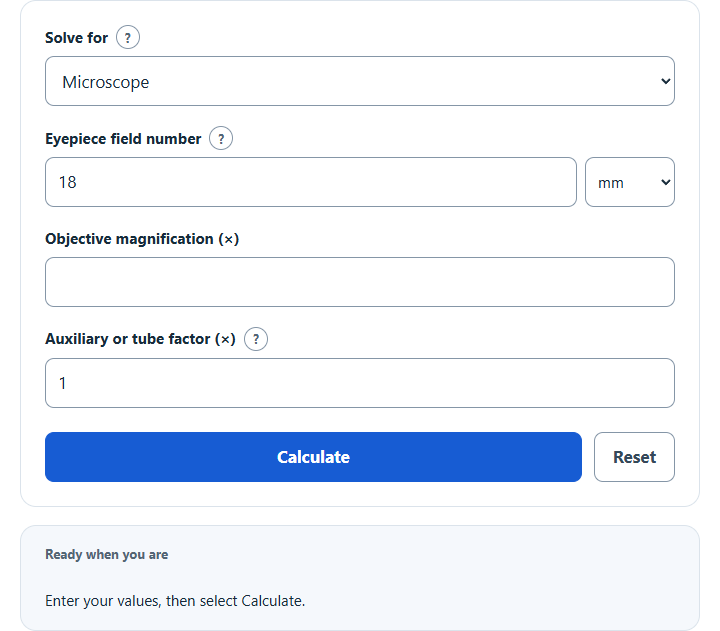
Calculate a microscope’s field of view diameter in mm and µm from objective magnification and eyepiece field number, or a telescope’s true field of view.
Calculator Functions
| Function | What it does | What it requires |
|---|---|---|
| Microscope | Finds the diameter of the circle of specimen visible through the eyepiece, in mm and µm, with its radius and area | Requires the eyepiece field number in mm and the objective magnification |
| Telescope | Finds the true field of view, the angle of sky visible through the eyepiece in degrees, with the magnification | Requires the eyepiece apparent field in degrees, the telescope focal length and the eyepiece focal length |
Microscope starts with a field number of 18 mm and an auxiliary or tube factor of 1, and Telescope starts with a Barlow or reducer factor of 1. Each of these can be changed. Focal lengths go in as mm, cm, m or inches.
Field of View Formulas
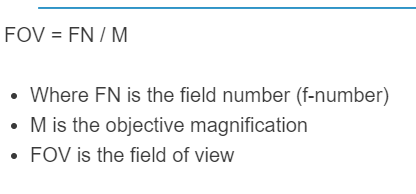
| FOV | Field of view diameter at the specimen (mm) |
| FN | Eyepiece field number, the diameter of the eyepiece field stop in mm [2]. On an eyepiece marked 10×/18 it is 18 |
| M | Objective magnification, such as 4, 10, 40 or 100 |
| A | Magnification of any auxiliary lens between the objective and the eyepiece. 1 when there is none |
Microscope
The field number is divided by the objective magnification, and an auxiliary lens multiplies the objective magnification before the division [1]. A 10×/18 eyepiece with a 40× objective shows a circle 18 ÷ 40 = 0.45 mm across, or 450 µm. The eyepiece magnification is not part of the formula, because the field number already describes the eyepiece. The result also gives the radius and the circular area, π × (FOV ÷ 2)².
| Objective | Field diameter, FN 18 | Field diameter, FN 20 |
|---|---|---|
| 4× | 4.5 mm | 5 mm |
| 10× | 1.8 mm | 2 mm |
| 40× | 0.45 mm (450 µm) | 0.5 mm (500 µm) |
| 100× | 0.18 mm (180 µm) | 0.2 mm (200 µm) |
Telescope
TFOV is the true field of view in degrees, AFOV is the apparent field of the eyepiece in degrees, F is the telescope focal length, f is the eyepiece focal length and B is the Barlow or reducer factor. A Barlow lens lengthens the telescope’s focal length, commonly to two or three times [3], so B is 2 or 3 for a Barlow and below 1 for a reducer. A 50° eyepiece of 10 mm focal length on a 1,000 mm telescope gives a magnification of 100 and a true field of 50 ÷ 100 = 0.5°. Adding a 2× Barlow doubles the magnification and halves the field to 0.25°. The result also shows an approximate field area, π × (TFOV ÷ 2)² in square degrees.
Limits of This Estimate
- The microscope result is the nominal field. The visible field can be smaller when the objective or another part of the optical path does not cover the full field number.
- Apparent field ÷ magnification is an approximation for telescopes. The eyepiece field stop, distortion and vignetting change the field that is seen, and a true field of 180° or more is rejected.
- Neither function covers a camera. A camera’s field of view depends on the sensor size and the focal length, not on an eyepiece.
Sources
- Nikon MicroscopyU, Field of View: field number divided by objective magnification, and the auxiliary lens rule
- Nikon Instruments, Glossary of Microscopy Terms, field number: field number as the eyepiece field stop diameter in mm
- Celestron, Astronomy Glossary of Terms: true field of view, magnification and Barlow lens