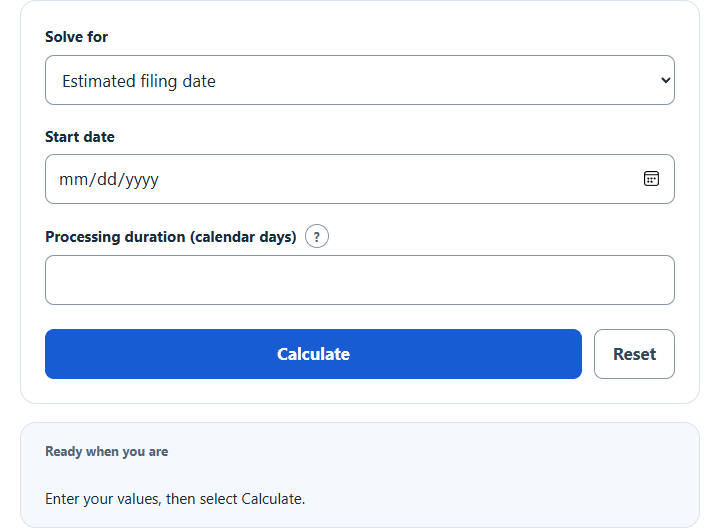
Calculate an estimated filing date by adding processing days to a start date, or work back to the start date or the number of calendar days between.
Related Calculators
- Appraisal Expiration Date Calculator
- Tenure Calculator
- Days To Retirement Calculator
- Rule Of 90 Calculator
- All Personal Finance Calculators
Calculator Functions
| Function | What it does | What it requires |
|---|---|---|
| Estimated filing date | Finds the date a set number of calendar days after a start date | Requires start date and processing duration in calendar days |
| Start date | Finds the start date that leads to a target filing date | Requires estimated filing date and processing duration in calendar days |
| Processing duration | Finds the number of calendar days between two dates | Requires start date and estimated filing date |
Durations are whole calendar days, so weekends and holidays are counted. The start date is day 0, and a duration of 0 returns the same date.
Filing Date Formulas
FD = SD + N
| FD | Estimated filing date |
| SD | Start date |
| N | Processing duration (calendar days) |
Estimated filing date
This is the formula above. A start date of March 2, 2026 with a processing duration of 45 days gives April 16, 2026.
Start date
SD = FD − N
To file by April 16, 2026 with 45 days of processing, the start date is March 2, 2026.
Processing duration
N = FD − SD
From January 15, 2026 to April 15, 2026 is 90 calendar days. The filing date must be on or after the start date.
Limits of This Estimate
- The result is a planning target, not an official filing date or a legal deadline. Agencies and courts set their own rules for cut-off times, receipt and postmark dates, and deadlines that land on a weekend or holiday.
- Every calendar day counts. A period measured in business days needs a different count.
- Dates are Gregorian calendar dates with no time of day, for years 0001 to 9999.