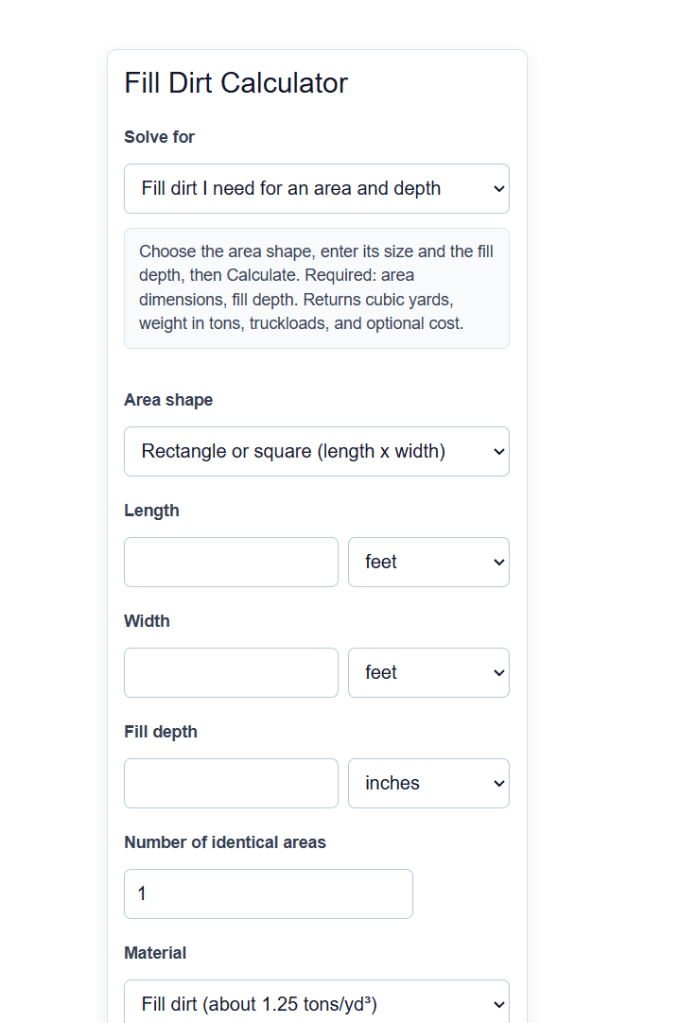
Calculate how much fill dirt you need in cubic yards, tons, and truckloads from your area and fill depth, with compaction and cost options.
Fill Dirt Formula
When you know the area and the fill depth, the volume of fill dirt is:
V = (A * D) / 27
When you know how much dirt you have and want the depth it will cover:
D = (V * 27) / A
To convert volume to weight:
W = V * Density
- V = volume of fill dirt in cubic yards
- A = area to be filled in square feet
- D = fill depth in feet (the calculator converts inches, yards, and meters to feet for you)
- W = weight of the dirt in tons
- Density = weight of one cubic yard of the material in tons (about 1.25 for fill dirt)
The calculator first turns every length you enter into feet, so you can mix units such as feet for length and inches for depth. It finds the area from the shape you pick (rectangle, circle, triangle, or a known area), multiplies by the depth to get cubic feet, then divides by 27 to report cubic yards. Choosing a material applies its density to report tons, and the advanced options let you add a compaction or waste percentage, set a truck capacity to estimate loads, and enter prices to estimate cost.
Fill Dirt Weight by Material
Loose density varies with moisture and source, so treat these as planning figures. Ask your supplier for the density of the specific load when weight matters for delivery.
| Material | Tons per cubic yard | Pounds per cubic yard |
|---|---|---|
| Fill dirt | 1.25 | 2,500 |
| Topsoil | 1.1 | 2,200 |
| Sand | 1.35 | 2,700 |
| Gravel | 1.4 | 2,800 |
Cubic Yards Needed per 100 Square Feet
This shows how much volume a given depth adds over a 100 square foot area. Multiply by your area in hundreds of square feet to estimate quickly.
| Fill depth | Cubic feet (per 100 sq ft) | Cubic yards (per 100 sq ft) |
|---|---|---|
| 1 inch | 8.33 | 0.31 |
| 3 inches | 25.0 | 0.93 |
| 6 inches | 50.0 | 1.85 |
| 12 inches | 100 | 3.70 |
Example Problems
Example 1. You want to fill a rectangular area that is 20 feet long and 10 feet wide to a depth of 6 inches with fill dirt.
- Area = 20 ft x 10 ft = 200 square feet
- Depth = 6 inches = 0.5 feet
- Volume = (200 x 0.5) / 27 = 3.70 cubic yards
- Weight = 3.70 x 1.25 = 4.63 tons
Example 2. You have 5 cubic yards of fill dirt and want to know how deep it will cover a 300 square foot area.
- Volume in cubic feet = 5 x 27 = 135 cubic feet
- Depth = 135 / 300 = 0.45 feet
- Depth in inches = 0.45 x 12 = 5.4 inches
FAQ
How much does a cubic yard of fill dirt weigh?
A cubic yard of fill dirt weighs roughly 2,200 to 2,500 pounds, or about 1.1 to 1.25 tons. Wet or clay-heavy dirt sits at the higher end, and dry sandy dirt at the lower end. The calculator uses 1.25 tons per cubic yard for fill dirt by default, and you can switch materials or enter a custom density.
Should I order extra fill dirt for compaction?
Yes. Loose dirt settles and is compacted as it is placed, so the volume in the ground is less than the volume delivered. Ordering 10 to 25 percent extra is common, with the higher figure used when you plan to run a plate compactor. Turn on the advanced options to add a compaction or waste percentage to the estimate.
What is the difference between fill dirt and topsoil?
Fill dirt is subsoil with little or no organic material, which makes it stable for raising grades, backfilling, and building up low spots. Topsoil contains organic matter and is meant for growing plants, so it compacts and settles more and is not used for structural fill. Use fill dirt for the bulk of a grade change and save topsoil for the final planting layer.