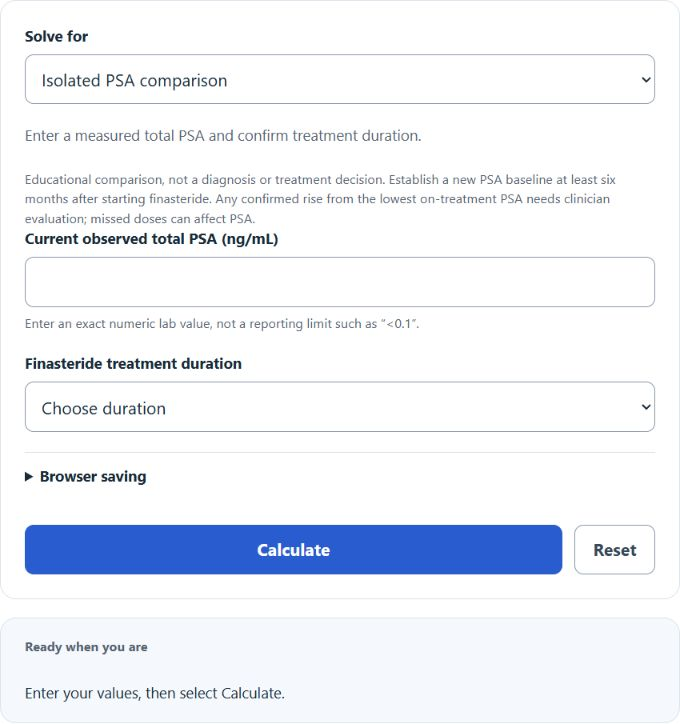
Apply the label-backed factor-two PSA comparison after six months of finasteride and review baseline or nadir changes with transparent calculations.
Important: Finasteride often lowers total PSA by about 50% within six months, but the response varies among individuals. Establish a new PSA baseline at least six months after treatment starts. Any confirmed increase from the lowest on-treatment PSA should be evaluated, even when it remains within an untreated reference range; missed doses can also affect results. This educational comparison does not diagnose cancer or determine testing or treatment.
Finasteride PSA Adjustment Formula
For an isolated total PSA value after at least six months of finasteride, the prescribing information describes doubling the measured value to compare with untreated reference ranges. Before six months, this tool applies no standard factor. This is a comparison value, not a measured untreated PSA or a diagnosis.
Variables:
- Adjusted PSA is the finasteride-adjusted PSA estimate (a rough value used for interpretation)
- PSA is the measured PSA value while taking finasteride
To calculate the finasteride PSA adjustment estimate, divide the PSA value measured while taking finasteride by 0.5 (equivalently, multiply by 2). This rule of thumb is used because finasteride often lowers PSA by about 50% within about six months of continuous use, but the effect is not uniform across individuals and depends on factors like duration of therapy, adherence, and biology. PSA interpretation should be discussed with a clinician.
Sources & notes
See the finasteride 5 mg prescribing information, section 5.1, for the six-month comparison rule, a new on-treatment baseline, evaluation of confirmed rises from the lowest value, and percent-free PSA. Individual interpretation belongs with the treating clinician.
Last reviewed: October 19, 2026
What is a Finasteride PSA Adjustment?
Finasteride PSA adjustment refers to applying an approximate recalibration to a PSA test result in men taking finasteride (a 5-alpha-reductase inhibitor used for benign prostatic hyperplasia and, at a lower dose, male pattern baldness). Because finasteride can reduce PSA levels by about 50% within about six months of therapy, clinicians may adjust the measured PSA by multiplying it by about 2 for interpretation. This can help interpret PSA results more consistently in people taking finasteride, but the best approach depends on the clinical context.
How to Calculate Finasteride PSA Adjustment?
The following steps outline how to calculate a finasteride PSA adjustment estimate.
- First, determine the PSA lab result measured while taking finasteride (PSA).
- Confirm treatment duration. At six months or more, the isolated total-PSA comparison is PSA × 2; before six months, no standard factor is applied here.
- Finally, calculate the finasteride-adjusted PSA estimate.
- After inserting the variables and calculating the result, check your answer with the calculator above.
Example Problem:
For example, an observed total PSA of 2 ng/mL after at least six months gives an untreated-range comparator of 4 ng/mL. With a pre-treatment value of 4 ng/mL and prior on-treatment nadir of 1.5 ng/mL, the comparator difference is 0, while the observed rise from nadir is 0.5 ng/mL (33.33%). These distinct arithmetic comparisons assign no diagnosis or testing threshold.
Adjusted PSA: the finasteride-adjusted PSA estimate
PSA: the measured PSA value while taking finasteride